Trust Framework
V2025-03-05 [4 min read]
Trust Frameworks enable the implementation of Schemes
Trust Frameworks operate at the sector level to collaboratively establish and maintain a light layer of identity management, governance, definitions, principles and open standards for data sharing, which create the foundations of a trusted data-sharing ecosystem.
Trust Framework: identity management, contracting, adoption and operation of Schemes, common principles
Scheme: rulebook for specific use cases (technical, legal, policy, operational)
Schemes are the rulebooks of how organisations can share data. They define what can be shared, why, by whom, how, and what protections exist. Trust Frameworks help apply the rules in a way that both humans and machines can understand. They enable monitoring, reporting and verification of those using the rules. This helps make sure the rules are being followed and offers ways to help enforce the rules when needed.
Example
For example, if you wanted to share electricity smart meter data with an app that helped reduce your energy bills, there are many different companies involved. As the one sharing that data you want to know it’s being handled properly, and that it won’t be misused. The benefit for the companies involved is that by having common rules, and ways of enforcing them, is that their risks are reduced. It can also help government and regulators influence, or regulate, rules that are needed to ensure markets are fair and open, unlock innovation and enable protections.
Good governance accelerates adoption
Governance helps convene the right organisations in the right manner
The implementation of Trust Frameworks can be mandated or voluntary, using legal vehicles through which Schemes can be implemented. An exemplar of this is the role of Open Banking Limited (non-profit) as the ‘implementation entity’ for the Open Banking Standard in the UK (regulated by the FCA).
IB1 is a non-profit that provides services that convene, facilitate and implement this.
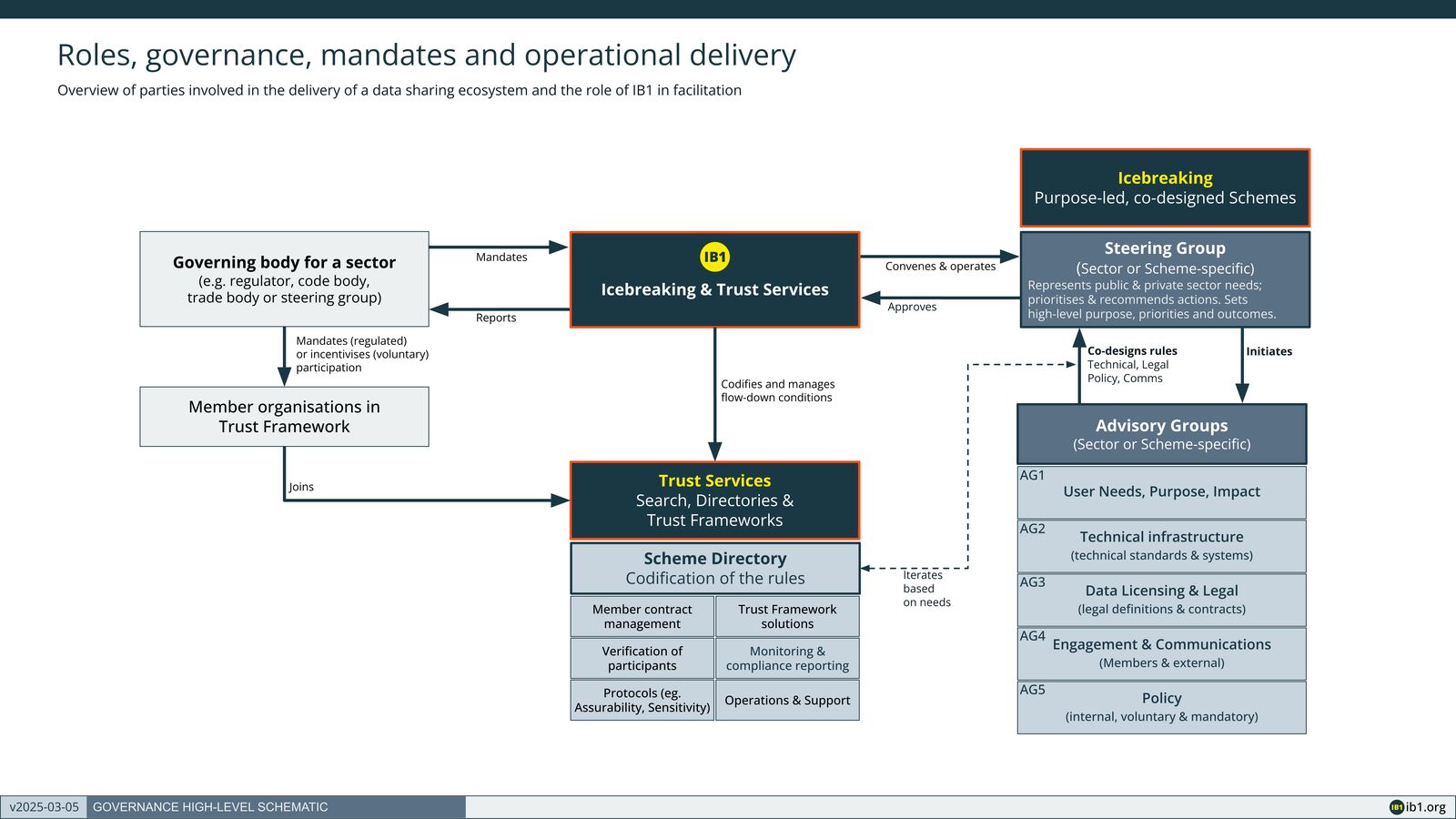
Trust Frameworks address the challenges of establishing trust in digital ecosystems, where traditional face-to-face verification methods and trust signals are not feasible. They are particularly important in sectors where secure and reliable data exchange is critical.
Trust Frameworks lay foundational ways for creating a trusted ecosystem for data sharing and identity management across a sector. Schemes build upon this foundation, tailoring the rules and practices to specific market-wide applications, thereby facilitating targeted and efficient data sharing and identity verification efforts.
Trust Frameworks are crucial for enabling secure, reliable, and efficient digital transactions and interactions, ensuring that all parties can trust the integrity and confidentiality of the data exchanged and the authenticity of the identities involved.
Trust Frameworks:
- Serve as the underpinning structure offering a comprehensive set of rules and guidelines for identity management, verification, and assurance within a sector.
- Facilitate assured data publishing by establishing common rules and standards that ensure data is accessible, interoperable, and usable across different entities and systems.
- Have their own governance structures to oversee the implementation, adherence, and evolution of the framework, ensuring it remains relevant and effective in addressing the needs of the sector.
Benefits for organizations
- Enhanced Security: Strengthening the protection of data and digital assets against unauthorized access and cyber threats.
- Increased Efficiency: Facilitating faster and more efficient digital transactions and interactions by reducing the need for repeated identity verifications and data exchanges.
- Improved Compliance: Helping organizations meet regulatory requirements related to data protection, privacy, trust, safety, competition and other relevant laws.
- Greater Interoperability: Enabling diverse systems and organizations to collaborate and share data more effectively.
- Boosted Confidence: Increasing the confidence of users and participants in digital transactions and interactions by ensuring that high standards of trust and security are maintained.
Key Components:
- Identity Verification and Management: Procedures and standards for ensuring that the identities of all parties involved in a transaction or interaction are accurately verified and managed throughout their lifecycle.
- Data Protection and Privacy Foundations: Foundational guidelines for Schemes that ensure data must be handled in compliance with laws and best practices, protecting sensitive information from unauthorized access or disclosure. In addition, for personal data, also ensures that their rights are addressed while enabling acceptable uses.
- Security Standards: Protocols, foundational guidelines and best practices for securing data transmission that reduce the risk of data breaches and cyber-attacks.
- Interoperability: Foundational guidelines for Schemes to ensure standards and protocols enable different systems, applications, and services to work together seamlessly, facilitating the smooth/low friction exchange of information across diverse platforms.
- Legal and Regulatory Compliance: Frameworks are designed to ensure that all activities conducted under their guidance comply with relevant legal and regulatory requirements, minimizing legal risks for participants and foundational guidelines for Schemes to ensure legal interoperability is considered in their design and implementation.
- Governance Mechanisms: An organisational structure that oversees the implementation, adherence to, and evolution of the framework. This includes defining roles and responsibilities, decision-making processes, and mechanisms for resolving disputes.
How Schemes and Trust Frameworks relate to each other
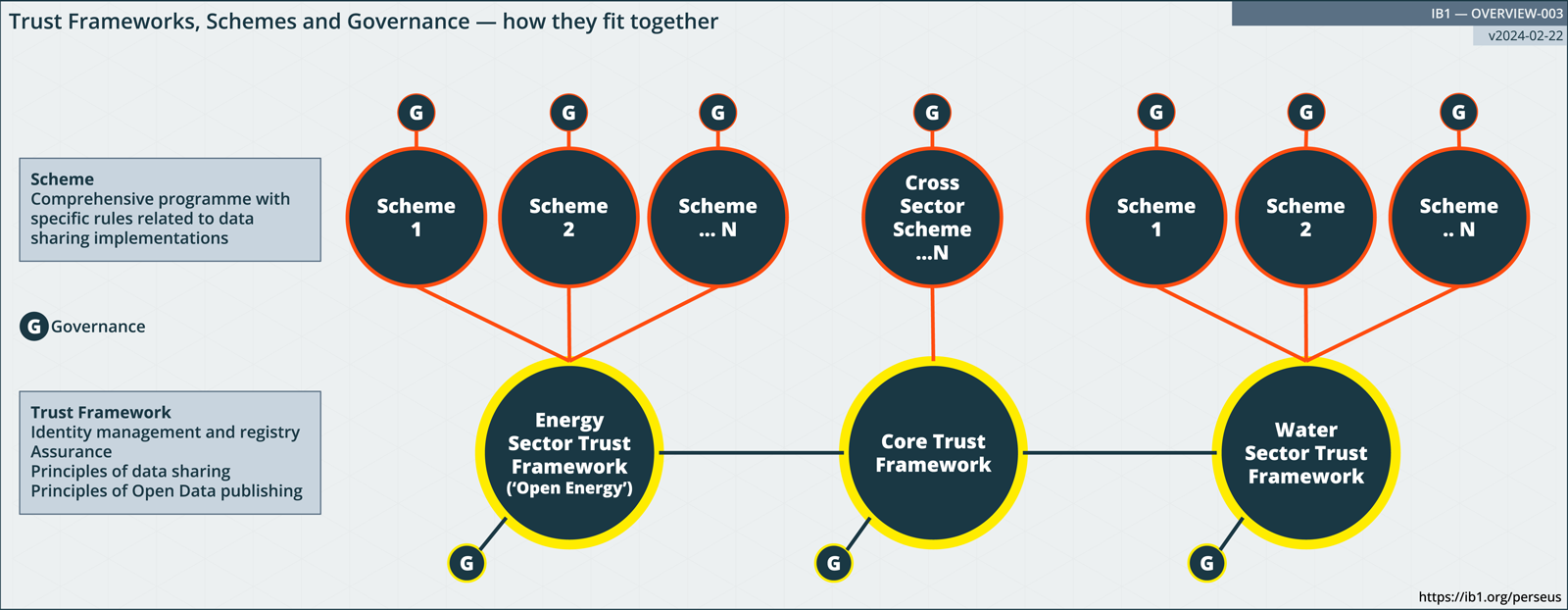
A Scheme is a specific set of rules, related to a particular market-wide use case within a sector. A Trust Framework is the umbrella set of rules for identity management, verification, assurance for a sector. Trust Frameworks embody common rules for Open Data publishing. Many Schemes can sit inside a sector Trust Framework. Trust Frameworks have their own governance and each Scheme can have their own governance. Schemes embody specific rules for Open and Shared Data publishing.
A good example of a cross-sector Scheme is Perseus as this will draw on data from across the economy (energy, water, finance, etc).
Schemes:
- Are specific sets of rules and protocols designed to address particular market-wide use cases within a sector. These use cases can vary greatly, from data sharing in energy markets to business identity verification in financial services.
- Focus on Shared Data publishing, providing detailed guidelines on how data should be shared, accessed, and used within the context of the Scheme. This includes considerations for data privacy, security, and technical and legal interoperability.
- Can have their own governance mechanisms tailored to the unique requirements and objectives of the Scheme, allowing for more focused and effective management and oversight.
Trust Frameworks lay the foundational rules for creating a trusted ecosystem for data sharing and identity management across a sector. Schemes then build upon this foundation, tailoring the rules and practices to specific market-wide applications, thereby facilitating targeted and efficient data sharing and identity verification efforts.