Generic Assurance Levels: An overview
Why assurance matters
Assurance helps improve the quality and transparency of information for decision-makers by making it clear what published data is, who is responsible for it, and what it can confidently be used for.
Trust Frameworks codify the technical and sociotechnical rules for data sharing agreed by their member organisations (these rulebooks are called Schemes). One core function of a Trust Framework is to provide proportionate verification and assurance of member organisations and the datasets they publish, across both Open and Shared data.
Assurance operates in two paired dimensions:
- Organisational assurance: who the publisher is and how they are governed
- Dataset assurance: what is published, how it is described, and how reliably it is maintained
IB1 Generic Assurance
A great place to start for many schemes
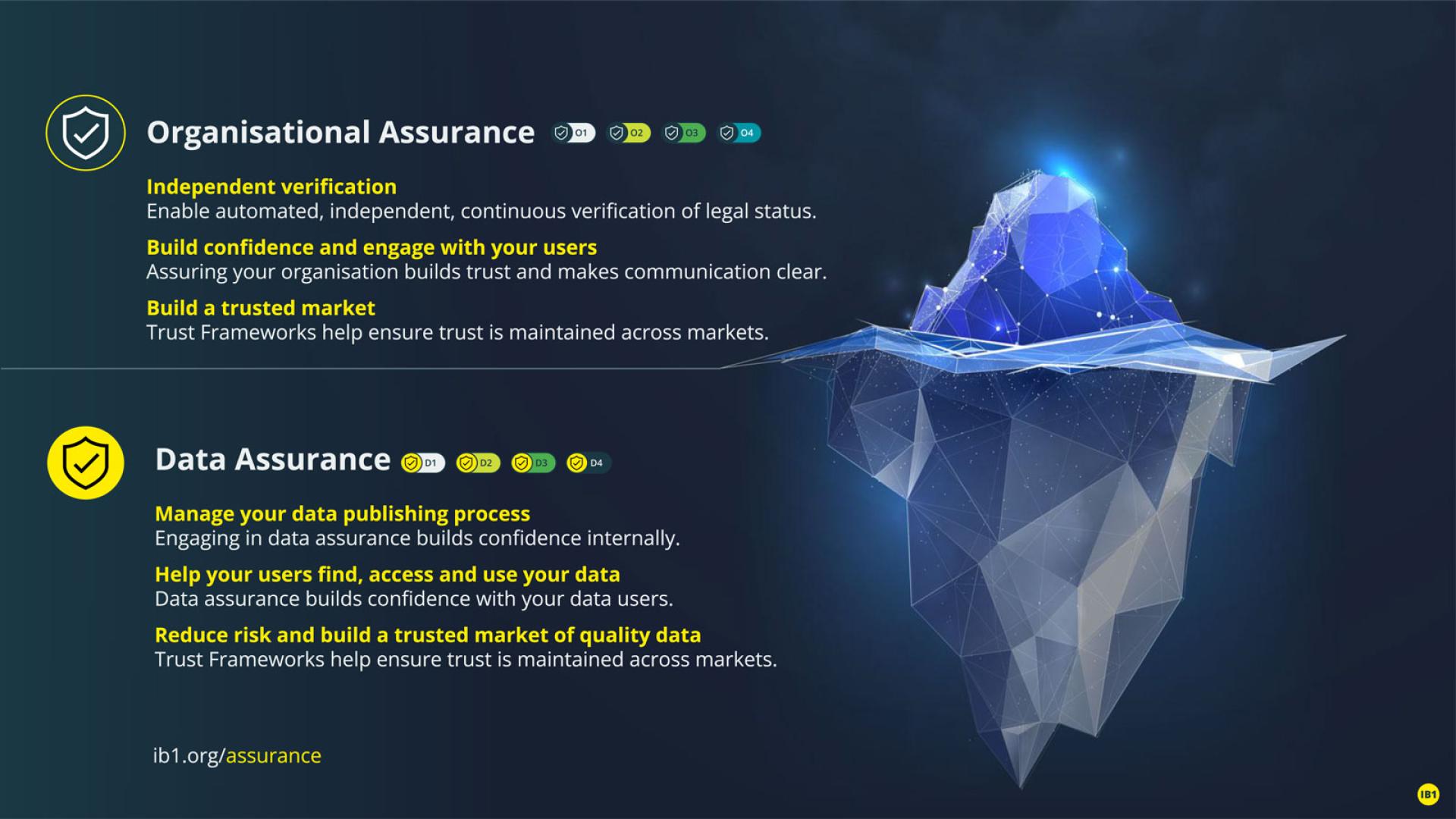
IB1 Generic Assurance is the baseline set of organisational and dataset assurance levels that schemes can adopt directly or extend with use-case-specific signals. The table below summarises what each level adds. Full requirements are maintained as machine-readable specifications, linked further down.
| Level | Organisation | Dataset |
| 1 | Identity verification, accountable roles, executed scheme agreement | Publicly-available machine-readable metadata, clear licensing, clear data sensitivity classification, no personal data |
| 2 | Adds cybersecurity requirements, user engagement, and a commitment to publish at Dataset Levels 1 & 2 | Adds data triage information, richer metadata, commitment to availability and support, basic interoperability |
| 3 | Adds clear data request processes, involvement in scheme governance, and a commitment to publish at Dataset Levels 2 & 3 | Adds provenance, higher availability, use of open standards, and openly-published data dictionaries or API specifications |
| 4 | Adds community building and a commitment to publish at Dataset Levels 3 & 4 | Adds machine-readable provenance, data descriptions, and licences |
Progression is cumulative: each level inherits the requirements of the level below.
Reading the levels
Level 1 establishes the minimum trustworthy entry point. The publishing organisation has been verified, has signed the scheme agreement, and the dataset is openly described, well-licensed, and free of personal data.
Level 2 moves from trustworthy entry point to operationally reliable: cybersecurity, user-facing support, structured metadata, data triage, and committed availability.
Level 3 brings governance and openness into clearer view: provenance, open standards, machine-readable API and data definitions, and active participation in scheme governance.
Level 4 turns the published data into reusable infrastructure: machine-readable licences and provenance, the highest availability targets, and an active publisher role in the surrounding community.
Signalling assurance
Once verified, organisations and datasets are entitled to display the corresponding badges. These provide a clear, human- and machine-readable signal to data users and downstream schemes.
Organisation assurance badges
| Badge | Label | Links to |
 | Organizational Assurance Level 1 | https://specification.trust.ib1.org/generic-organization-assurance-levels/1.0/#organization-assurance-level-1 |
 | Organizational Assurance Level 2 | https://specification.trust.ib1.org/generic-organization-assurance-levels/1.0/#organization-assurance-level-2 |
 | Organizational Assurance Level 3 | https://specification.trust.ib1.org/generic-organization-assurance-levels/1.0/#organization-assurance-level-3 |
 | Organizational Assurance Level 4 | https://specification.trust.ib1.org/generic-organization-assurance-levels/1.0/#organization-assurance-level-4 |
Dataset assurance badges
| Badge | Label | Links to |
 | Dataset Assurance Level 1 | https://specification.trust.ib1.org/generic-dataset-assurance-levels/1.0/#dataset-assurance-level-1 |
 | Dataset Assurance Level 2 | https://specification.trust.ib1.org/generic-dataset-assurance-levels/1.0/#dataset-assurance-level-2 |
 | Dataset Assurance Level 3 | https://specification.trust.ib1.org/generic-dataset-assurance-levels/1.0/#dataset-assurance-level-3 |
 | Dataset Assurance Level 4 | https://specification.trust.ib1.org/generic-dataset-assurance-levels/1.0/#dataset-assurance-level-4 |
Detailed requirements
The full machine-readable requirements for each level are maintained as formal specifications:
Schemes may adopt these as-is or extend them with use-case-specific requirements. See the Open Energy Assured Open Data Scheme for a worked example.