Facilitating the co-design of Schemes
Icebreaking is IB1's structured process to convene organisations around a shared purpose and helping them co-design data sharing Schemes. It addresses the hardest part of data infrastructure: getting organisations with competing interests to agree on rules, roles, standards and responsibilities in a pre-competitive space. Done well, good governance doesn't add delay, it accelerates adoption.
People often know what problems they would like to solve. However, getting organisations with competing commercial interests to agree on pre-competitive rules, implement them, and sustain governance over time is hard. In the UK, the Data (Use and Access) Act creates new mandates for both personal and business data sharing. Icebreaking is the methodology that makes it achievable and repeatable.
Icebreaking convenes multidisciplinary, multi-sector groups to define the rules, roles, and responsibilities that govern data sharing. Using its structured process and secretariat, IB1 helps industry co-design Schemes [definition] that enable harmonised, low-friction, and secure data sharing, covering legal, technical, policy, and communications requirements.
Any constellation of three or more organisations can request to originate an Icebreaking programme. IB1 provides structure, facilitation, and institutional memory to turn shared intent into implementable Schemes. Identifying needs are the first step, then building the business case and a coalition that can sustain it through implementation to adoption.
Icebreaking operates in a pre-competitive space: organisations collaborate on governance rules before they compete on products and services. IB1 is neutral, non-partisan non-profit and its involvement ensures balance, can facilitate anti-competition challenges and competitive tensions. Resulting Schemes are openly licensed to stimulate open markets.
Technology is rarely the ‘problem’. Many data sharing schemes fail due to unresolved legal, policy, and commercial challenges. Icebreaking explicitly ‘grasps the nettle’ to cover five fundamental areas: purpose and user needs, technical infrastructure, data licensing and legal, engagement and communications, and policy and regulation.
The rules co-designed through Icebreaking flow directly to IB1 Trust Services: codified in machine-readable format in its Registry, implemented operationally, and continuously improved through a feedback loop between live Scheme evidence with governance-led iteration.
Every Scheme co-designed through Icebreaking is aligned with NOVA: compliant with a Networked, Open, Verifiable Architecture. This ensures interoperability with other Schemes and Trust Frameworks, including Open Banking, and positions participating organisations at maturity levels 4-5 of the NOVA scale.
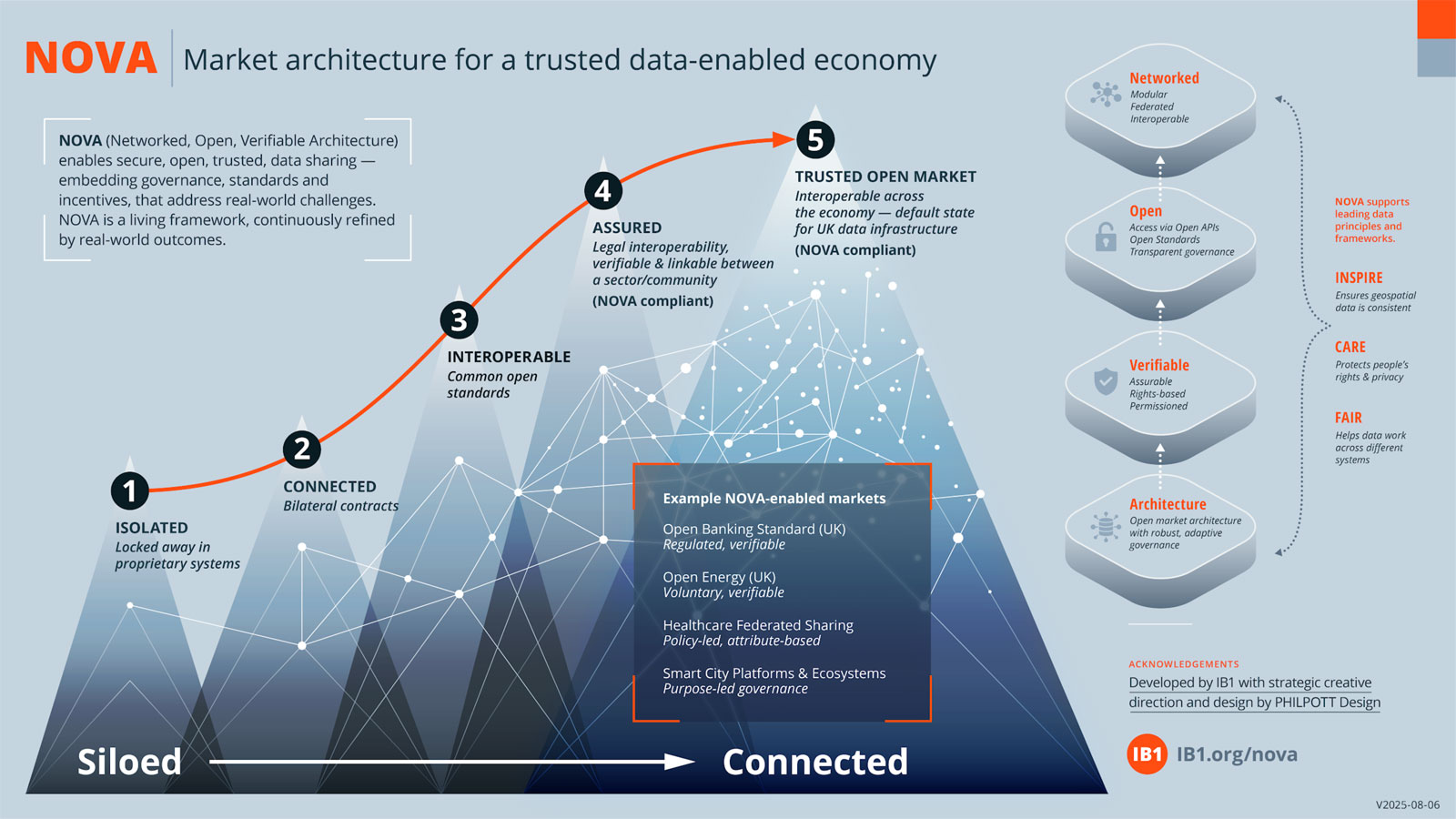
All Schemes are designed to be interoperable to enable data flows across sectors without rebuilding governance from scratch for each combination.
All outputs are open (CC-BY) by default. Steering and Advisory Group minutes are published openly online. Anyone can inspect, verify, and Members can adopt Schemes.
Schemes define how assurance is achieved and what rights govern access. Rules are machine-readable, auditable, and persistently versioned.
Schemes are designed for open markets, not to create a gatekeeper. Governance is designed to enable adaptation as Schemes evolve.
Icebreaking is a comprehensive and structured governance programme with a secretariat, formal advisory groups, published minutes, with accountability to a Steering Group and independent Delivery Oversight Committee (if relevant). IB1 has run this across energy, water, sustainable finance, insurance, supply chains, and nature data.
Strategic and tactical leadership on purpose, representative of public and private sector needs. Prioritises and recommends actions, sets high-level purpose, priorities, and outcomes. Final approval over the Scheme rules. Typically 10-20 sector leaders, commercial, non-commercial, government and regulator observers depending on the complexity of the Scheme.
Commercial actors and experts who co-design the rules to meet the needs of the market and the purpose. Five groups cover distinct domains, report and recommend to the Steering Group. Open recruitment ensures broad sector representation and Working Groups of domain experts support each AG.
IB1 provides neutral secretariat functions: scheduling, facilitation, minute-taking, publication of outputs, programme management, and institutional memory across all groups. This is the work that makes governance sustainable rather than episodic.
All IB1 Icebreaking outputs are openly licensed (CC-BY). Minutes, consultations, use case outputs, and draft Scheme documentation are published openly during the design process. This creates a public record and enables broader market participation and innovation.
Schemes are not static: as Trust Services operate live Schemes, evidence flows back to governance through the defines-and-iterates loop. This can enable adaptive policy. The Steering Group and Advisory Groups update rules based on real-world outcomes and IB1 maintains the Registry through each iteration.
Where a use case has market or public benefit, Innovate UK, UKRI, and other public funders are realistic co-bid targets. IB1 has extensive experience co-bidding and delivering government-funded and philanthropic programmes. The Seed stage of Icebreaking is often eligible for co-bid support from first engagement.
A full Icebreaking programme operates a Steering Group with up to five Advisory Groups, each covering a distinct domain. Working Groups of domain experts support each. This structure has been proven across many programmes.
Business case, ecosystem map, impact assessment, and user needs analysis. Defines the purpose of the Scheme and the specific user needs it must address. Ensures Schemes remain grounded in real-world demand rather than technical possibility.
Standards choices, operations and systems: selects, aligns and harmonises appropriate technical architecture, API specifications, data standards, security profiles, assurance and provenance mechanisms. Aligned with open standards including FAPI, NOVA, FAIR, and IB1 Open Library specifications. Relevant Strategic Partners can engage across all AG2 [technical] groups.
Contracts, liability, and data rights: defines the legal framework for data sharing, including licensing models, liability allocations, consent and permission requirements, and dispute resolution. Reduces pre-competitive friction in an increasingly complex data landscape.
Members and external stakeholders define how the Scheme is communicated to participants, regulators, and the public. Manages the ongoing narrative that sustains engagement over time.
Corporate and public policy: ensures the Scheme is aligned with current and emerging policies and regulation. Engages with national government, regulators and code bodies as authoritative contributors in regulatory consultations. NB: IB1 is not a lobbying organisation.
Icebreaking is structured in four stages: each stage has clear costs, outputs, and decision points.
IB1 has run Icebreaking programmes across energy, water, insurance, sustainable finance, supply chains, and nature data. This has convened hundreds of organisations, hundreds of use cases, and produced world-class, peer-reviewed outputs.
If you have a use case and think at least two other organisations may be willing to explore it, you have enough to start: Discover is a low-friction entry point and IB1 will do the heavy lifting.
All programmes CC-BY licensed / IB1 is non-partisan, non-profit, and sector-neutral.