Data sharing manifesto for a Net Zero Future
Priority mandates for a Net-Zero Future:
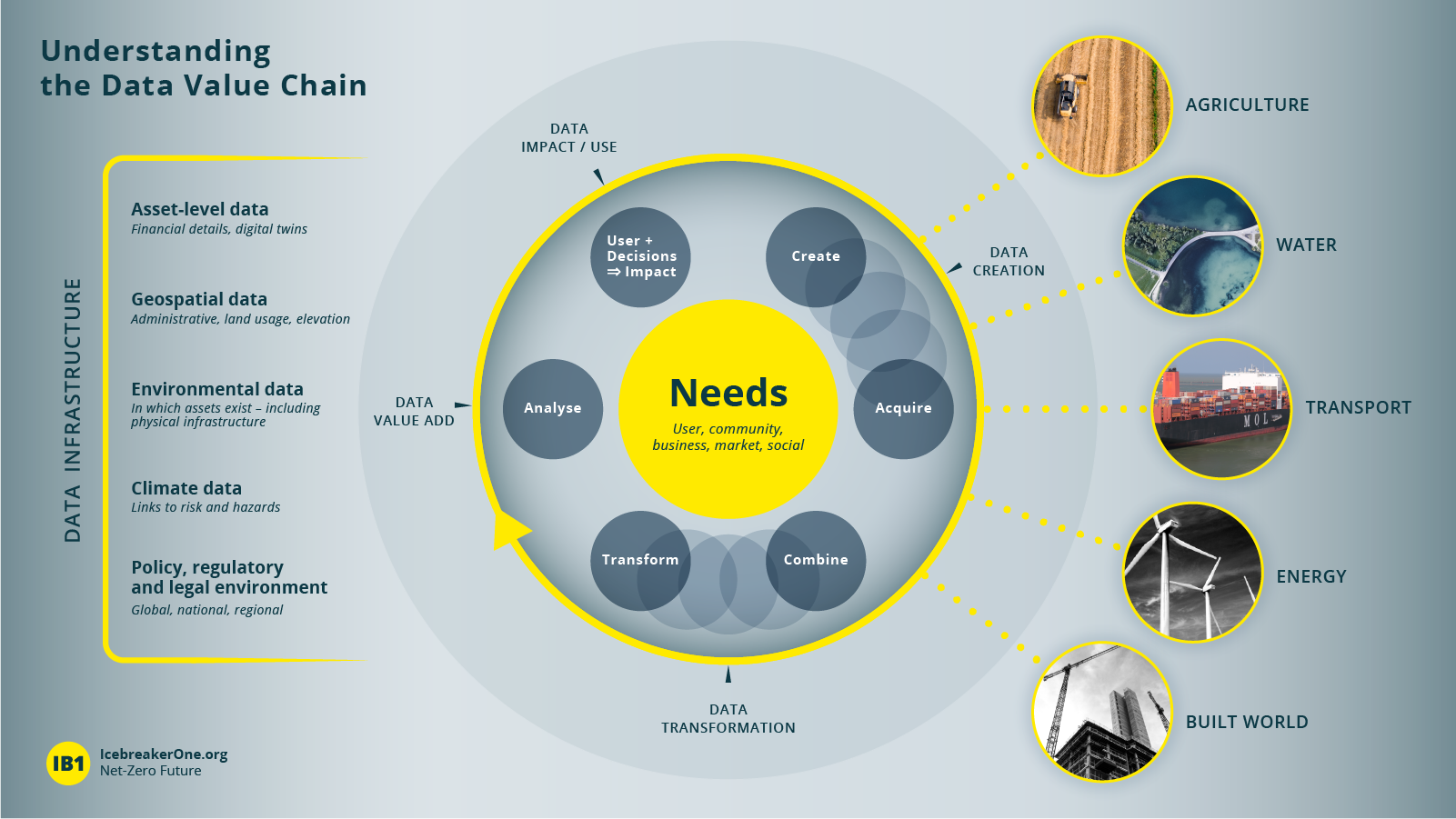
- Mandate that data be made accessible across Finance, Agriculture, Water, Transport, Energy and the Built World.
- Mandate market participation (stimulate open market behaviours across all actors)
- Mandate evidence-based targets (= demonstrable net-zero returns relevant to the financial sector)
Building on the ODI’s manifesto for sharing engineering data below, we highlight the areas where Icebreaker One (IB1) is helping to operationalise finance and industry data sharing at sector-scale.
- IB1 works across sectors to engage industry around Net-Zero climate-challenge led programmes across finance, energy, built world, agriculture, water and transport.
- IB1 is committed to helping unlock access to Shared Data — see our report on a market design for data sharing.
- IB1 opertionalises national data infrastructure through initiatives such as Open Energy — directly addressing regulatory, IP, legal, technical and business model challenges around specific sector-wide needs.
All Icebreaker One outputs are openly licensed by default, and covers any data type (ODI’s framing around engineering data can be generalised to other areas).
We are developing a set of Icebreaker Principles for data sharing based on the manifesto below: https://ib1.org/icebreaker-principles/
We have built on the ODI manifesto for sharing engineering data below to address both finance and industry data.
Introduction
Globally we are facing a range of economic, industry and environmental challenges. To create a safer, more sustainable and resilient future we need to improve our built environment and infrastructure to a changing climate.
Increasing access to data, while preserving trust and ensuring benefits to the public good, are key to ensuring that our economies and societies will thrive. Making better use of data will enable us to innovate, create more efficient and effective services and products, increase resilience and fuel economic growth and productivity.
To create a world where data works for everyone will require leadership from across the industrial sector. Change will require experimentation and trialling new approaches and ways of working. The organisations endorsing this manifesto believe that the following principles and actions are vital steps towards maximising value of data for the public good.
1. Data is infrastructure
Data is infrastructure that powers our societies and economies. Data infrastructure consists of data assets, the technologies, standards and guidance that inform their collection and use, and the organisations and communities that manage, use and benefit from it.
To treat data as infrastructure:
- Governments should identify data that is part of our national infrastructure and ensure it is invested in to ensure access, quality and security
- Standards bodies must work across sector to support the development and adoption of data and metadata standards that support the sharing and use of data
- Professional bodies and societies should define and enforce codes of practice and guidelines that will inform how data is accessed, used and shared.
2. Data must be stewarded
Data should be managed as an asset to maximise its value to society. Managing data as an asset will make it easier to access, use and share.
Treating data as an asset will require:
- Making data discoverable and accessible, ensuring it is well-documented and accompanied by standard metadata that describes its provenance, quality and limitations
- Ensuring sustainable long-term access to data, through skilled curation and use of appropriate approaches to data sharing and archiving
- Industry collaboration to design and adopt principles and frameworks, such as the Gemini Principles1, that will guide the collection and use of data
- Organisations involved in delivering projects and maintaining infrastructure must adopt approaches to deliver projects that support collectively managing data for the public good.
3. Opening and sharing data unlocks value
Data should be as open as possible, while protecting people’s privacy, commercial confidentiality and national security. Data from multiple organisations is needed to address challenges and the data needs to be accessible.
To unlock value from data:
- Governments should publish foundational data assets, like geospatial and weather data, under an open licence
- The private sector must share and open datasets to increase access to data that will drive innovation and support research
- The public sector must embed requirements for opening and sharing data within procurement processes and should not sign contracts that allow for exclusive access to data
- Funders and regulators should use their powers to increase access to data.
4. Explore new data sharing models
Trustworthy data infrastructure will be independently governed and sustainably funded to ensure equitable access to the data and the benefits created from it, while minimising any harmful impacts.
To enable new models for sharing data:
- Funders, legislators and regulators should create incentive schemes that encourage collaboration and the sharing of data
- Governments and regulators should invest in platforms and approaches that will facilitate the sharing and exchange of data
- The public and private sector should recognise the range of approaches to increasing access to data and adopt models that will help to maximise the value of data while minimising harms.
5. Use challenges to drive innovation that solves problems
Open innovation can enable new solutions to important social, economic or environmental challenges, like increasing safety in the workplace or on our road networks.
To drive innovation through a challenge-led approach:
- Governments and civil society should work together to highlight key social, economic and environmental challenges that might be addressed through innovative approaches
- Funders should invest in programmes that will enable collaboration across the private sector, startups and researchers, to solve specific challenges through the better use of data
- Funders should help innovators to scale and develop their solutions by supporting the creation of necessary data infrastructure that underpins these new products and services.
6. Regulation must adapt to new technologies and uses of data
As new technologies, like autonomous vehicles, are designed and deployed it is important that the necessary data is available to enable innovation, provide evidence of safety and inform public policy.
To help adapt regulation to new technologies and uses of data:
- Existing regulation that applies to sectors will need to be extended or adapted to meet this changing environment by increasing access to data
- The regulators themselves will also need to develop their own capacity to use data, their understanding of the role data plays in their sector, and their understanding of when, where and how to intervene in the sector.
7. Building data literacy and skills
Organisations need the capacity to make use of data and an understanding of how to share it safely. To achieve this, data literacy and skills will need to increase across the industry professions and organisations, and a range of stakeholders will need to collaborate.
To help build data literacy and skills in sectors:
- Professional bodies and societies should ensure that their professional development and certification courses are building data skills
- Universities and research organisations must ensure that they are teaching the necessary data skills required for the future of the profession
- Private sector companies should design their internal skills and learning programmes to build an understanding of the value of data at all levels of their organisation.
8. Ensure data is used legally and ethically
Increasing volumes of data are being collected about homes, buildings, roads and transport networks, and employees in the workplace. This data must be used in ways that bring value for the public good, while minimising any harmful impacts that data use could bring.
To ensure data is used legally and ethically:
- Organisations must comply with relevant legislation
- Organisations collecting personal data should be transparent about how it is being collected, used and shared. They should also engage with their workforce and communities to understand both their needs and their expectations about how data about them might be used
- Professional bodies and individual organisations should develop and enforce codes of practice that will guide the ethical use of data, and ensure that the choices made about what data is collected and how it is used should not be unjust, discriminatory or deceptive.
9. Share knowledge and insight
Not every solution will work everywhere but, to achieve the greatest benefits to the public good, knowledge and insight should be shared within organisations, across the sector and internationally.
Countries differ in the state of their physical and data infrastructure, in their laws and regulations and in their attitudes to sharing and using data. But, by sharing experience and best practices, it will make it easier to tailor those insights to local contexts.
To support sharing of knowledge and insight:
- Funders of research should mandate open access and open data to ensure the widest dissemination and application of its results
- Individuals leading projects within organisations and across sectors can share insights and best practices
- Professional bodies should develop case studies, tools and guidance that will facilitate the sharing of best practices.