

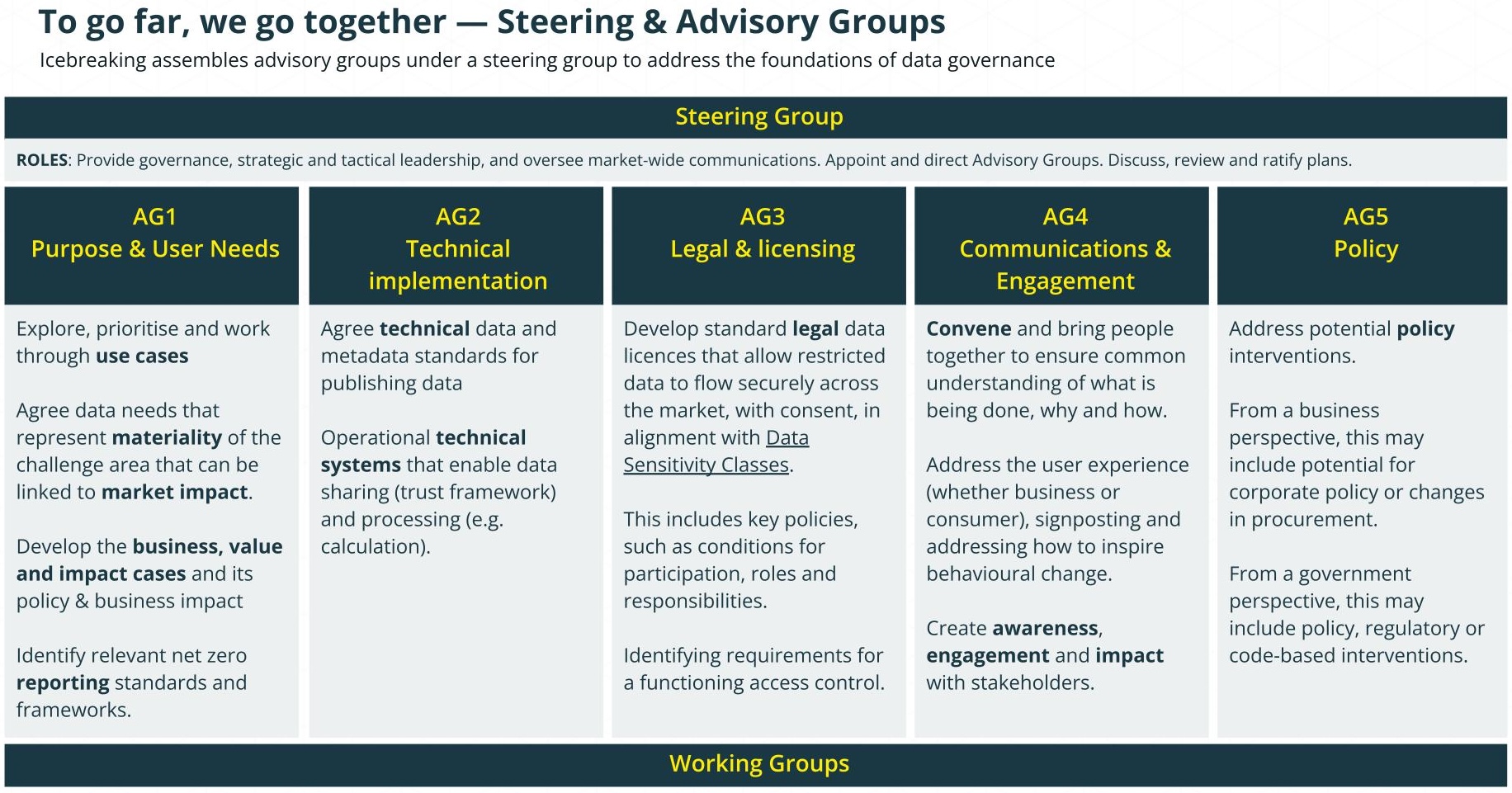
- Advisory Group 1: User needs & impact
- Advisory Group 2: Technical implementation
- Advisory Group 3: Legal & licensing
- Advisory Group 4: Communications & engagement
- Advisory Group 5: Policy
A PDF version can be found here.
Perseus Overview
Perseus will help unlock access to finance that reduces emissions, by automating sustainability reporting for every SME business in the UK. To go far together, Persues employs a robust governance process comprising a Delivery Oversight Committee, a Steering Group (SG), 5 Advisory Groups (AGs), and Working Groups (WGs). Full details of IB1’s governance process can be found at https://ib1.org/sops/governance-schemes
All Perseus Advisory Groups and members commit to respecting the Terms of Reference: https://ib1.org/terms/agtor, which outline member and co-chair roles and responsibilities.
2026 Quarterly roadmap
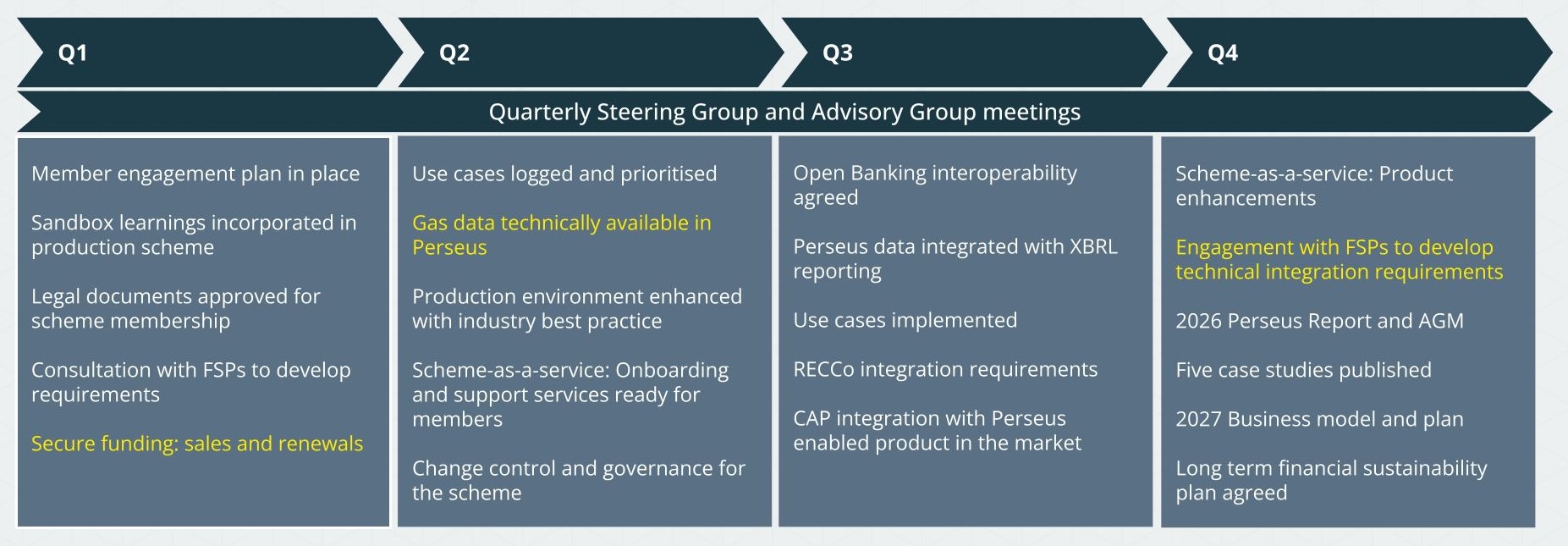
Perseus 2026 scope
2026 will continue the focus on go-to-market: operating and maintaining the sandbox and production environment, onboarding more members, particularly FSPs, and making any necessary improvements to the implementation and processes.
AG1: User Needs & Impact
Purpose:
AG1 focuses on understanding and addressing the needs of the four primary user groups: Small and Medium Enterprise (SMEs), Carbon Accounting Providers (CAPs), Energy Data Providers (EDPs) and Financial Service Providers (FSPs). It also works to identify other user groups, define their needs, and prioritise use cases that align with the mission of Perseus. AG1 ensures that user perspectives are integrated into technical, legal, and policy developments, fostering a user-centric approach across the Scheme.
AG1 2026 focus areas include:
- Engagement with FSPs to develop requirements
- Use cases logged and prioritised
- Scheme-as-a-service product enhancements
- Onboarding and integration (support materials)
- Interoperability with RECCo and emerging schemes such as Smart Meter Consent
- Use case development
- Alternative revenue streams for operations and increasing membership value
Outputs:
- Insights from sandbox participants on matching Perseus to use cases
- Review and potential enhancement of the methodology used to calculate emissions
- Identification and prioritisation of new use cases to expand the Scheme
- Collaboration with other AGs to integrate user requirements into technical, legal, and policy frameworks
- Opportunities for engagement and testing Perseus solutions with additional SMEs
- Actionable feedback from participants to drive continuous improvement.
- Contributions to the 2026 report, including synthesised feedback and recommendations for the 2027 roadmap
- AG1 co-chair reports progress, key decisions and risks to the Steering Group
Recommended skills and expertise:
- Ability to identify and prioritise use cases aligned with strategic goals
- Strong communication and collaboration skills to engage with other AGs and stakeholders
- Expertise in commercialisation and product development cycle
- Skills in synthesising user feedback into actionable recommendations for programme improvement
- Meeting facilitation expertise for AG co-chairs (full AG co-chair role description here)
Frequency of meetings: Quarterly, lasting 1-1.5hrs.
AG2: Technical implementation
Purpose:
This group advises on the technical standards, specifications and infrastructure required to deliver Perseus’ current use case and future prioritised use cases. It also covers the “developer experience” of organisations integrating with Perseus, including the sandbox, documentation, example code and other technical onboarding materials.
AG2 2026 focus areas include:
- Scheme-as-a-service onboarding and support services ready for scheme members
- Operation and maintenance of sandbox and live environment
- Onboarding and integration (support materials, technical support)
- Gas data technically available in Perseus
- Subject to AG1 adoption/prioritisation:
- Streamlined permission using CAP-held address information
- Market-based emissions
- Interoperability with RECCo and emerging schemes such as Smart Meter Consent
- Integration with XBRL
- Greater automation for at-scale use, e.g. Compliance monitoring, audit tooling
Outputs:
- Production system specification, identification, commissioning and deployment
- Agreed changes to the production Registry
- Review and signoff for technical documentation
- Onboarding and KYC processes
- Operational policies
- Contribute to the 2026 report
- AG2 co-chair reports progress, key decisions and risks to the Steering Group
Recommended skills and expertise:
- Knowledge of building or operating financial or similarly secure data processing environments
- Experience leading or advising on the architecture and implementation of at-scale online services
- Experience with standard systems, processes and technologies for integrating online services (for example REST APIs, OAuth, PubSub)
- Understanding of the implementation of services acting as data suppliers and/or data consumers
- Technical expertise in metadata publishing and maintenance, managing data catalogues, managing data
- Experience with technical policy and compliance
- Meeting facilitation expertise for AG co-chairs (full AG co-chair role description here)
Frequency of meetings: Quarterly, lasting 1-1.5hrs.
AG3: Legal & licensing
Purpose:
AG3 focuses on developing and refining standard legal data licences to enable secure data flows across the market, ensuring consent where relevant. It aligns with Data Sensitivity Classes and access control frameworks to meet the needs of a production environment. AG3 also establishes key policies, such as conditions for participation, roles, and responsibilities, while addressing the necessary licences and requirements for effective access control. This Advisory Group is convened on an ad hoc basis when legal & licensing changes occur.
AG4: Communications & engagement
Purpose
This group addresses the communication of the benefits and value case of Perseus, and driving behavioural change to encourage uptake. The outputs of this group are intended to create awareness, engagement and impact with stakeholders.
AG4 2026 focus areas include:
- In person events and online engagement
- Making the most of gas data addition to improve engagement
- developing tailored messaging and communication strategies to highlight the advantages of the Scheme for different user groups.
- engaging with Advisory Group members’ organisations and conduct broader communications to build awareness and impact with stakeholders
- detailing a 2026 communications plan
- collecting of evidence showcasing successes from the Perseus
- developing communications materials as needed for key stakeholder groups
- contributing to the 2026 report by presenting stakeholder engagement outcomes and success stories to support broader Scheme adoption.
Outputs:
- Messaging and communication of the benefits for different user groups
- Engagement with Advisory Group members’ organisations, and where relevant Steering Group bodies
- Open Engagement through broader consultation with the industry
- A detailed 2026 communications plan
- Contribute to the 2026 report
- AG4 co-chair reports progress, key decisions and risks to the Steering Group
Recommended skills and expertise:
- Communications professionals specialising in the sector(s) relevant to the programme
- Understanding how to digest and articulate user benefits
- Experience in developing communications plans
- Meeting facilitation expertise for AG co-chairs (full AG co-chair role description here)
Frequency of meetings: Monthly, lasting 45min.
AG5: Policy
Purpose:
AG5 focuses on developing and refining policies that meet regulatory requirements and align with established standards, such as the Partnership for Carbon Accounting Financials (PCAF). It prioritises creating internal policies for Financial Service Providers (FSPs), Carbon Accounting Platforms (CAPs), and Energy Data Providers (EDPs), ensuring compliance with regulations while protecting the interests of SME beneficiaries. AG5 also supports data governance and promotes ethical data usage practices across the Scheme. This Advisory Group is convened on an ad hoc basis when policy changes occur.