
[reading time: 5 mins]
As Perseus co-chair, members, stakeholders, and the broader community tell me that it is seen as a pioneering initiative, with a significant scale of opportunity (at least £5B+ in embedded sustainable finance), but there are still challenges in communicating what it is, and isn’t, and ‘why now?’.
“Collaborate on the rules, compete in the game.”
The course is set, now it’s time to shape how value is realised
Perseus is now recognised as a flagship exemplar under the UK Data (Use and Access) Act, supported by both the Smart Data Council (in its Smart Data Strategy for 2035) and the Net Zero Council. The regulatory current is moving in this direction, and the Perseus team is both in constructive conversations with regulators and code bodies, and at the table in creating the UK Smart Data guidebook.
Perseus Members are defining where the rules of embedded sustainable finance are being written. The question isn’t whether this infrastructure gets built, it’s who helps shape it, and who arrives late.
To help better position what Perseus is, here are some of my reflections, based on 300+ conversations.
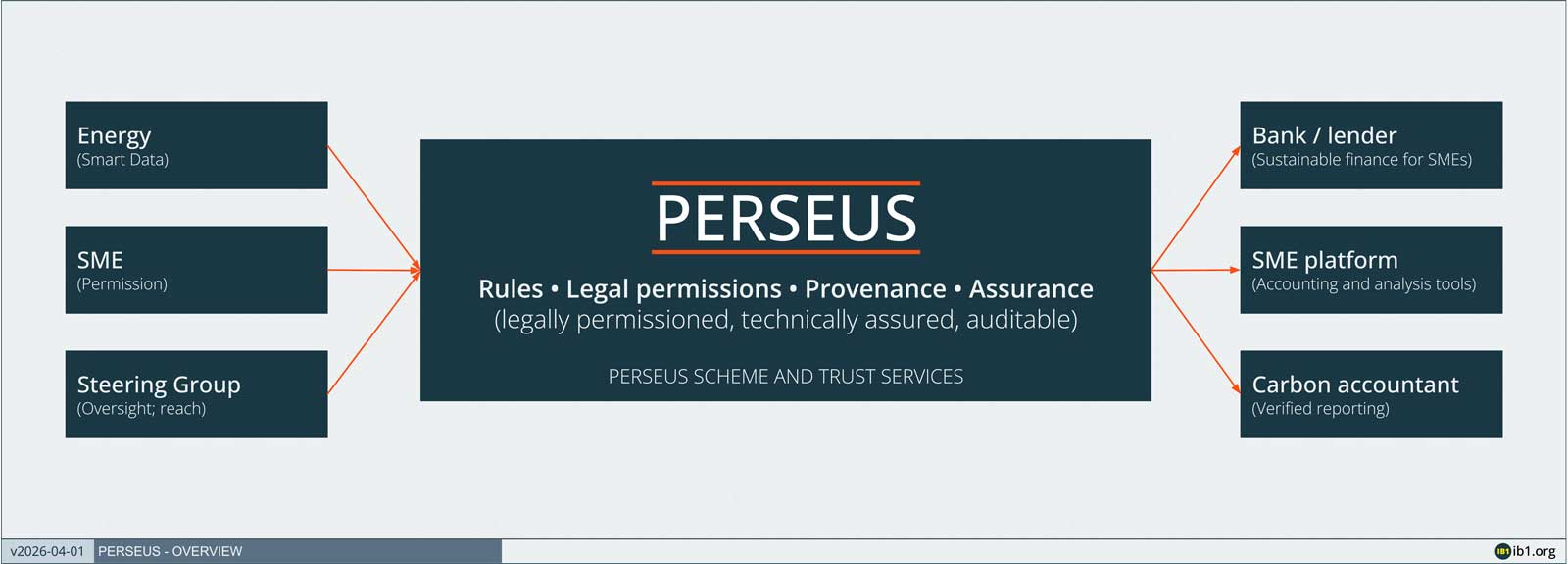
Getting the data to do the work: SME impact at market scale
SMEs are where the impact is needed (they are half of UK business emissions). For the vast majority, carbon reporting is a burden: manual, confusing, inconsistent, and disconnected from anything that actually helps them run their business better.
Perseus flips this: with the SME’s permission, their energy data flows automatically into their accounting platform and to their lender. No spreadsheets, no data entry, no consultants: they get a verified emissions baseline, access to sustainable finance products they can’t easily reach, and a credible sustainability story they can use with their own customers and suppliers.
Perseus meets them where they are, through the tools and relationships they already have, and costs them almost nothing to participate. Reducing friction and cost is the point of good data infrastructure, getting smart data to do the work so the SME gets the benefits, and the market gets the scale.
Perseus is infrastructure, not a product
Most responses to addressing SME carbon emissions follow a familiar playbook: build an app, sign up users, grow a dataset, and sell reporting services. Some go further and package insights as a commercial proposition. Both hit the same ceiling: they create value for their own customers, but they don’t change the market.
“Carbon reporting can often be seen as a random number generator linked to compliance, not value.”
Data silos are no longer business moats
When data stays siloed and calculations stay inconsistent, every bank, accountant, lender, software provider keeps solving the same problem independently, at their own cost. Multiply that across the whole economy and you have a colossal, systemic waste of time and money: with no true comparability, little trust, and no efficiency of scale. As one senior expert put it, “it’s a random number generator linked to compliance, not value“.
“Perseus meets SMEs where they are, through the tools and relationships they already have, and costs them almost nothing to participate.”
Perseus takes a structurally different route (the same route Open Banking took). The design of Open Banking wasn’t to ‘make a better banking app’, it was that if you agree the rules by which data flows between any bank and any third party, every player in the market benefits simultaneously, and the infrastructure becomes self-reinforcing as more join.
Perseus applies exactly that logic to SME emissions data: not a pipe, not a platform, a Scheme. A Scheme is a shared rulebook that defines how the data flows, it is legally permissioned, technically assured, and provenance-stamped between energy data sources, carbon accountants, and lenders, regardless of which specific providers are involved.
Schemes are designed to ‘do as little as possible’ so that the heavy lifting that they do deliver, can deliver at scale. Perseus is not a database, or a calculator, or a portal. Instead it’s the trust layer that makes everyone else’s products work together, enables solutions to go to where the customer already is, and makes them credible due to the governance wrapped around its design.
“Perseus is not a database, or a calculator, or a portal. It’s the trust layer that makes everyone else’s products work together.”
No single organisation can build what Perseus builds collectively
Any carbon accounting platform can reach its existing customers, any energy data business can find organisations already looking for a data feed, any bank can bring these things together, but none of them can, on their own, shift the behaviour of 5.5 million SMEs and the financial system that serves them.
Perseus can because its Steering Group and commercial membership collectively represent the whole system: the banks, accountants, energy companies, trade associations, and SME platforms that already have the customer relationships. The joint communications that can flow from this coalition don’t just amplify awareness, or make ‘business today’ more efficient, it creates an addressable market that didn’t previously exist. By going far together, they can all reach SMEs who have never considered net zero was for them, through channels they already trust: their bank, their accountant, their software tools, and their trade association. Perseus is creating a route to market no individual organisation can replicate through its own sales effort, and this is estimated to be £5B-£10B by 2030 (see 2025 annual report).
Its benefits can compound in both directions: automating data flows that currently require manual effort, reducing the cost of compliance, reducing friction at every point in the chain and building customer trust not for one product, but at market scale.
“Perseus Members are defining where the rules of embedded sustainable finance are being written. The question isn’t whether this infrastructure gets built, it’s who helps shape it, and who arrives late.”
The value case for a Financial Services Provider (e.g. bank, lender)
There are reasonable objections a bank or lender might raise. Right now, Perseus is a UK SME Scheme, not where the biggest financed emissions numbers sit for most large institutions; they may have existing bilateral data arrangements they’re reluctant to revisit; and in a climate where public sustainability commitments are under scrutiny anything that looks ‘new’ can face internal resistance.
These are valid questions, but they don’t change the underlying logic.
In impact, most initiatives measure engagement, they rarely measure or report on verifiable impact. Perseus enables continuous, assurable measurement, reporting and verification of impact. By harmonising the approach, the reporting is comparable across organisations.
On scale: the UK SME market is not a rounding error but half of all UK business emissions. Any lender with a material SME book has a financed emissions reporting problem that carries sufficient risk to increase their cost of capital. Perseus addresses this across the whole market at once. Perseus Members have indicated that ‘just’ energy (electricity and gas) addresses over 70% of their use cases, and the programme is designed to expand beyond energy based on Member needs (e.g. water). If we go far together, our collective impact is material and meaningful.
On existing bilateral arrangements: Perseus doesn’t replace them, it improves them through harmonisation of approach, liability and technical provenance. Joining doesn’t unwind existing relationships, rather it gives them an additional trust layer, aligned with the Data Act and endorsed by the Net Zero Council.
On the commitment: Perseus is not a ‘climate pledge’, but an action to deliver the data infrastructure for embedded sustainable finance. Operationally, it’s equivalent to joining any financial data scheme – a technical and commercial decision, not a public statement about net zero ambition. It supports diverse go-to-market impact messaging across cost savings, energy efficiency, energy security, net zero and transition planning. It’s not a campaigning approach, but rather a way to deliver measurable value to the market.
“Any lender with a material SME book has a financed emissions reporting problem that carries sufficient risk to increase their cost of capital.”
On governance and legal overhead: Perseus’ architecture is deliberately modelled on Open Banking. Its legal agreements, certificate infrastructure and KYC processes are designed to align with what regulated financial institutions already do (the path through legal and compliance is not trivial, but it is well-trodden).
Ultimately, the financial providers already in Perseus are sitting in the room where the rules of sustainable finance data infrastructure are being written. It is a choice to be a late adopter of a model that Perseus members helped design, for a membership fee and some internal process. The cost of joining later is accepting the rules written by others.
The value case for a Carbon Accounting Providers (whether financial or carbon management)
A CAP might ask: why do we need Perseus? (we already have integrations with energy data providers, have bank and lender customers, and are building the product that does this).
These are fair points, but miss what Perseus is.
“Perseus is not a database, or a calculator, or a portal. It’s the trust layer that makes everyone else’s products work together.”
Every CAP currently solving this problem is solving it alone: each has negotiated its own data access arrangements, built its own ingestion pipelines, made its own judgements about data quality, and written its own terms. The result is a market where every emissions calculation is done differently, every audit trail looks different, and no two outputs are directly comparable. That’s not a CAP problem to fix, it is a market structure problem, and no single CAP can fix market structure.
This has been the case for decades. Now the baseline calculation needs to become pre-competitive infrastructure (co-designed and delivered by the market) so that CAPs can compete on the value they build on top of it.
Collaborate on the rules, compete in the game
Perseus addresses this by establishing a common trust layer (common legal agreements, provenance standards, assurance levels, harmonised calculations) so that data flowing into any Perseus-connected CAP is verified, traceable, and comparable to data flowing into every other. This doesn’t commoditise the CAP’s product, but rather makes the CAP’s product something an SME or bank can actually rely on, report against, and put in front of an auditor with confidence.
On distribution: joining Perseus is not just a technical integration but access to a network of lenders, trade associations and SME platforms that collectively reach the entire UK SME market. This is a route to market no CAP can replicate through its own commercial efforts. Perseus-connected CAPs are not just selling software but access to a trusted, standards-aligned data flow that their competitors outside the scheme cannot match.
On the competitive question: the CAPs already building Perseus integrations reach hundreds of thousands of UK SMEs today. They are not waiting before positioning themselves within it. Waiting until Perseus is ‘already proven’ before engaging will find the integrations, the relationships, and the market positioning is already occupied.
On effort: Perseus adds a compliance overhead, but this is inversely proportional to scale. The cost of integrating once (which can be done in under a month) with a common framework is substantially lower than maintaining multiple bespoke bilateral arrangements as the market grows. Perseus reduces long-run complexity, it doesn’t add to it.
Spend-based estimates or manually uploaded spreadsheets are no longer fit-for-purpose. Perseus provides the foundations that CAPs can build on top of, creates trust, defensibility, reduces long-term costs, increases market engagement and innovation.
To go far, we go together.