Market architecture for a trusted data-enabled economy
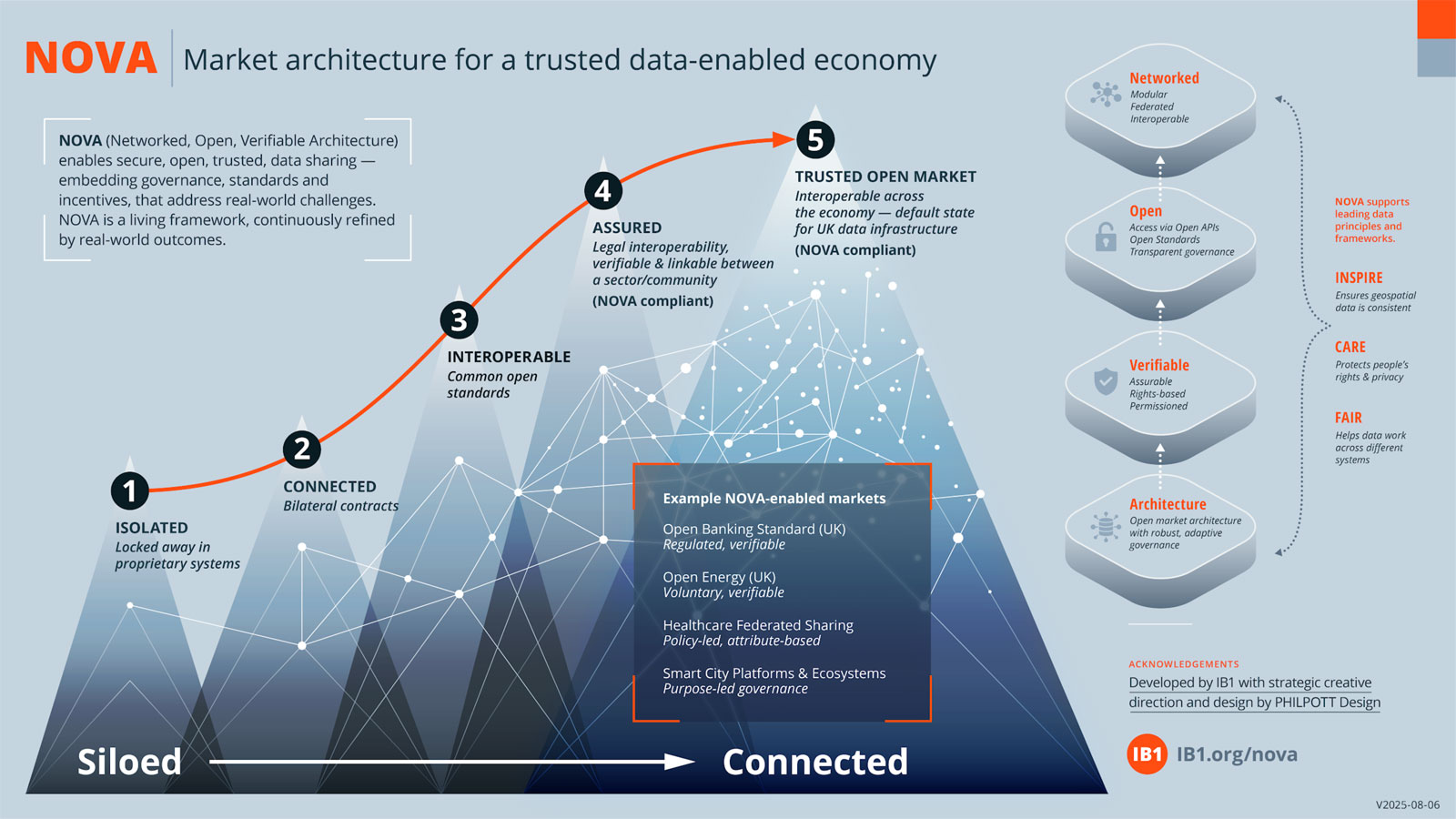
NOVA is a framework to help understand how markets can be architected when data flows between multiple actors. It aids discussion and strategic development around how interoperable rules, governance, and infrastructure can connect across sectors while ensuring data flows are lawful, rights-based, and fit-for-purpose. NOVA-compliant markets are how open economies can work at scale.
Markets need rules. Data markets are no different. A NOVA-compliant solution embodies a coordinated structure of interoperable rules, governance, and infrastructure that connects actors across sectors while ensuring data flows are lawful, rights-based, and fit-for-purpose.
NOVA is not a platform or a standard. It is a framework to ensure platforms, organisations, and institutions can collaborate safely, transparently, and competitively. It reflects the way markets are working and evolving today, including Open Banking, the direction of the recent UK Data Act, and pioneering initiatives such as Perseus, Open Energy, and Open Property.
Modular, federated, and interoperable infrastructure that supports many actors, many platforms, many jurisdictions. No central gatekeeper. Data infrastructure must let organisations join, participate, and leave without breaking the whole.
Open standards, open APIs, and transparent governance. Standards openly accessible and usable by anyone. Web-addressable interfaces for machine-enabled data exchange. Clear, accurate, and timely disclosure of policies, decisions, performance and impact.
Assurable, rights-based, and permissioned data access. Membership, transfer, and use can be audited, tracked, and held to account. Data sharing is codified in contract between assured members. Where relevant, permission or consent is given or pre-authorised.
Optimises for market access while enabling adaptive governance. Any verifiable actor can enter. Rules can be defined, iterated, and enforced at market-relevant pace. Private, public-benefit, and national interests are all addressed.
Delivering NOVA-enabled markets requires coordination between commercial, non-commercial, research, and government actors, whether the resultant outcomes are regulated or not. Data lakes and other centralised databases are also members of and participants in an open market.
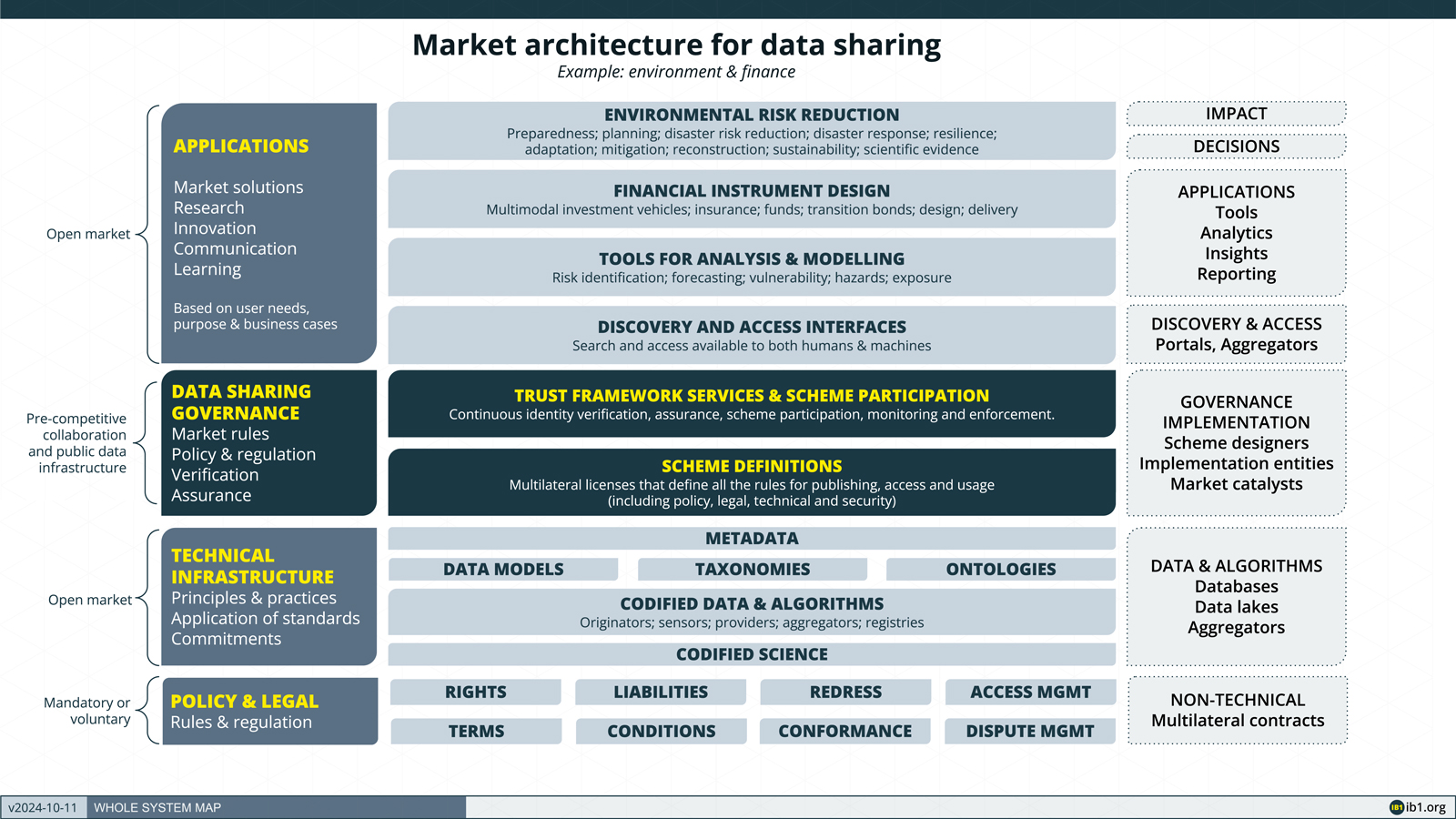
NOVA reflects the processes behind trusted data sharing on the web: networked participation, built on open standards, backed by verifiable processes. It blends centralised, collaborative governance with decentralised data sharing to build connected ecosystems of trust.
Embody what is needed in a repeatable, cohesive, and scalable manner. Components can be reused, replaced, and recomposed without rebuilding the whole.
Support the coexistence of multiple platforms, protocols, and providers. No single implementation is required to participate.
Systems (technical, legal, and operational) must interact with low cost and friction, with harmonised approaches across boundaries.
Standards openly accessible and usable by anyone. No licence fees, no gatekeepers, no vendor lock-in on the specifications themselves.
Web-addressable interfaces that enable machine-enabled data exchange. Programmatic access is a first-class concern, not an afterthought.
Clear, accurate, and timely disclosure of policies, decisions, performance, and impact. Governance decisions are auditable by participants and observers.
Joining as a member, and enabling data transfer and use, can be audited, tracked, and held to account. Trust is demonstrated, not asserted.
Data sharing is based on legal and related rights, codified in contract, and enabled between assured members. Rights are the foundation, not a compliance overlay.
Where relevant, or required by law, permission or consent is given from the business or consumer, or pre-authorised permission is determined by contract.
Data infrastructure must optimise for market access while enabling adaptive governance. Whether market participants are data providers or data users, the architecture must ensure an open market that iterates at market-relevant pace.
Enable any Verifiable actor to enter the market. No permission required beyond meeting the verifiable criteria set out in the Scheme. Barriers to entry are technical and legal, not political.
Define, iterate, enable, and facilitate scalable enforcement of the rules. Governance must move at market-relevant pace, not legislative timescales.
Ensure private sector, public-benefit, and national interests are addressed. NOVA does not favour any one type of participant; it defines the conditions under which all can operate together.
If you do not have specific insights at the end of the pipeline, why are you building it? Every NOVA-compliant Scheme starts with declared purpose. Purpose constrains what the market does and does not need to do.
NOVA focuses on market governance, with an architecture that supports the design and delivery of sector-specific and cross-sector data sharing initiatives. Use it to frame the questions that market designers must answer.
Which market actors should be involved? Data providers, data users, regulators, certifiers, intermediaries, end users. NOVA helps map each and clarify their role.
What rules and roles are required for trusted participation? Membership criteria, obligations, sanctions, dispute resolution.
What legal and technical infrastructure is required to operate at scale? Contracts, APIs, identity, assurance, provenance.
How can interactions be managed with policy, regulation, and codes to enable lawful data flows? NOVA-compliant Schemes align with regulation rather than substituting for it.
What interoperability conditions are required for scale, reuse, and redress? Common vocabularies, harmonised contracts, shared identity, cross-Scheme dispute paths.
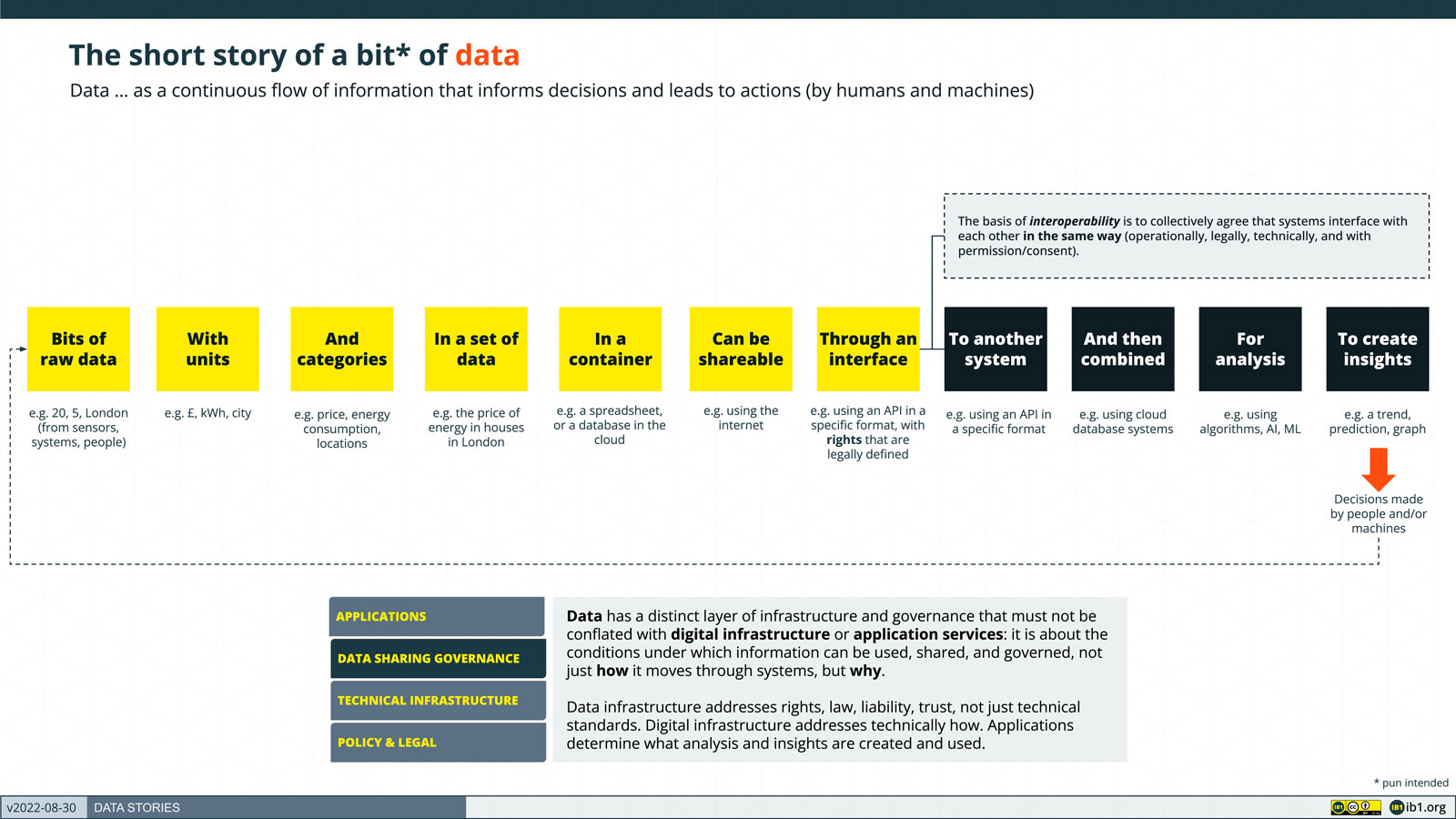
“Data” is not one thing. Digital infrastructure and data governance are different categories. If you do not address data through the lens of a market architecture, you create friction rather than removing it.
Digital and technical infrastructure sit in a different category from data governance. NOVA-compliant Schemes address both.
Data spans systems and organisations. It is transmitted, stored, and shared in many different ways. What helps data flow is a combination of governance, policy, law, and technology, anchored around purpose.
We can produce examples for any sector. If a sector-specific NOVA diagram would help your work, contact research@ib1.org.
NOVA is a shared vocabulary for market architecture. If you are designing, regulating, or participating in a data sharing initiative and want to test its market architecture against these principles, we would like to hear from you. Comments welcome via email, on the open Google Doc, or via LinkedIn.
Please cite as: IB1, https://ib1.org/nova. NOVA is CC-BY licensed. IB1 is independent, non-partisan, non-profit, and sector-neutral.