Ecosystem organisations: focus, purpose and examples
This page is cross-referenced by Perseus 2025, Open Energy, STREAM, Carbon Commons, Discover, Cygnus, and SERI.
You can use the layer view below to orient and follow links out to primary sources. Related IB1 ecosystem maps: CEFID (2019) and CFI (2021). See our Glossary and briefing on reporting and disclosure.
How to use this
We present the ecosystem as a stack that tracks across the data value chain, from measurement in the real economy through to the coalitions that mobilise action. Each layer contains a table of representative actors with a badge showing what kind of actor they are.

Standard formal specification; Framework guidance or methodology; Regulation statutory or mandatory;
Platform data or analytics services; Research academic or research body; Coalition multi-party initiative;
Intermediary data intermediary or trust service; Certifier assurance or certification body
Layer 1Real economy and measurement
Focus: quantifying emissions, resource use and environmental impacts at the source.
Purpose: generate primary measurements that feed every other layer and set the internationally recognised methodologies for doing so. When measurement is inconsistent the entire stack may become unreliable.
| Organisation | Type | What it does | Notes |
|---|---|---|---|
| GHG Protocol | Standard | Corporate, Product Life Cycle, and Scope 3 accounting standards. The de facto global standard for corporate GHG accounting. | Comprehensive Corporate Suite update in progress; new versions expected 2027. |
| ISO | Standard | Publishes ISO 14001 (EMS), ISO 14064 (GHG quantification and reporting), ISO 14067 (product carbon footprint), ISO 14040 / 14044 (LCA), and related standards. | See ISO reference block below. |
| UK Defra | Regulation | Publishes UK GHG conversion factors and the Environmental Reporting Guidelines used by UK-domiciled reporters. | Annual update cycle. |
| US EPA | Regulation | Runs the US GHG Reporting Program and publishes emission factors and inventory guidance used across North America. | |
| European Environment Agency (EEA) | Platform | EU-level environmental data, indicators, and monitoring across climate, air, water, and biodiversity. | |
| Science-Based Targets initiative (SBTi) | Framework | Sets criteria for corporate emissions reduction targets aligned with 1.5C pathways. Corporate Net-Zero Standard. | Corporate Net-Zero Standard v2 through consultation 2024 to 2026. |
| PCAF | Standard | Global standard for measuring and reporting financed emissions for banks, asset managers, insurers. | Sits inside the GHG Protocol Scope 3 architecture. |
| Carbon Trust | Certifier | Product and organisation carbon footprint methodologies, verification and certification services. | Co-authored GHG Protocol ICT Sector Guidance. |
| Ember | Platform | Open electricity generation and carbon intensity data used across the sector, including by CO2.js and others. | |
| Climate TRACE | Platform | Independent, satellite-derived facility-level GHG emissions inventory covering major emitting sectors globally. | |
| Grantham Institute (Imperial), CISL (Cambridge), Oxford Sustainable Finance | Research | Applied research on climate risk, transition finance and environmental economics informing methodology and policy. | UK CGFI is hosted at Oxford. |
Layer 2Data infrastructure and interoperability
Focus: the plumbing that lets measurements move at market-wide scale under agreed rules.
Purpose: provide the trust frameworks, data intermediaries, data spaces, and digital sustainability schema needed for parties to share data safely, verifiably and interoperably.
Trust frameworks, data intermediaries and data spaces
| Organisation | Type | What it does | Notes |
|---|---|---|---|
| Icebreaker One | Intermediary | Independent, non-partisan, non-profit. Builds and operates trust frameworks for market-wide data sharing across energy, water, finance, transport, built world and agriculture. | Precompetitive layer. |
| Open Data Institute (ODI) | Framework | Guidance, research and training on data infrastructure, data ethics, and open data. | |
| UK DIATF | Regulation | UK statutory trust framework for digital identity and attribute services. | |
| Data Spaces Support Centre (DSSC) | Coalition | EU-funded centre coordinating cross-sector data spaces work. | |
| Gaia-X | Framework | European federation for sovereign, interoperable data and cloud services. | |
| IDSA | Standard | Reference architecture, connectors and certification for sovereign data exchange. | |
| Solid Project | Standard | W3C-linked specifications for decentralised personal data storage and access. | |
| UK Smart Data schemes | Regulation | UK statutory Smart Data schemes under the Data (Use and Access) Act. | |
| UK National Data Library | Framework | Proposed UK infrastructure for safe access to public sector data for research. | IB1 contributed to Wellcome / ESRC Technical White Paper Challenge. |
| GLEIF vLEI | Standard | Verifiable Legal Entity Identifier: globally unique, cryptographically verifiable identity. | |
| OpenID Foundation, W3C | Standard | Underlying identity, authentication, credential and semantic web standards. |
Digital sustainability schema and methodology
| Organisation | Type | What it does | Notes |
|---|---|---|---|
| Green Web Foundation | Framework | Stewards DIST, CO2.js, and carbon.txt. | |
| Green Software Foundation | Standard | Software Carbon Intensity (SCI) specification (ISO/IEC 21031:2024) and Impact Framework (IF). | Under the Linux Foundation. |
| W3C Web Sustainability Guidelines | Standard | 93+ guidelines and 232 success criteria for sustainable web products. | |
| Sustainable Web Design (SWDM) | Framework | Open methodology (v4) for estimating website carbon emissions. | |
| Boavizta | Framework | Open data, methods and tools for ICT environmental impact assessment. | |
| ITU-T L.1480 and L.1470 | Standard | ICT sector emissions and net enabling effects standards. | |
| GHG Protocol ICT Sector Guidance | Standard | Product LCA guidance for ICT services and hardware. | |
| EGDC | Coalition | Net Carbon Impact Assessment Methodology for ICT solutions. | |
| SDIA | Coalition | Digital Environmental Footprint concept and open data hub. | |
| Climate Neutral Data Centre Pact | Coalition | Self-regulatory framework for European data centres by 2030. | |
| iMasons and Open Compute Project | Standard | Embodied Carbon Disclosure Base Specification for data centre equipment. |
Layer 3Reporting and disclosure standards
Focus: what organisations should disclose about their sustainability performance, and how.
Purpose: establish comparable, decision-useful information for investors, regulators, customers and the public.
| Organisation | Type | What it does | Notes |
|---|---|---|---|
| ISSB (IFRS Foundation) | Standard | Global baseline for sustainability disclosures. IFRS S1 and S2 published 2023, adopted or referenced by 30+ jurisdictions. | Absorbs SASB, VRF, CDSB and TCFD monitoring. |
| EFRAG / ESRS | Standard | European Sustainability Reporting Standards mandated under CSRD. | Sector-specific standards deferred under the Omnibus package. |
| VSME | Standard | Voluntary Sustainability Reporting Standard for non-listed SMEs. Published Dec 2024. | Referenced by Perseus. |
| GRI | Standard | Multi-stakeholder sustainability reporting standards focused on impacts. | Interoperability agreements with ISSB and EFRAG. |
| TNFD | Framework | Nature-related risk and opportunity disclosure with LEAP methodology. Over 500 adopters. | ISSB progressing nature standards building on TNFD. |
| CDP | Platform | Global environmental disclosure system. Aligned to IFRS S2, ESRS and GRI. | Foundational data provider to the Climate Data Utility. |
| SBTN | Framework | Science-based targets for nature, land, freshwater and oceans. | |
| EDM Council, OMG | Standard | Semantic and technical data standards for machine-readable sustainability reporting. | |
| WBCSD | Coalition | CEO-led coalition producing implementation guidance on ISSB and ESRS. | |
| EFFAS | Coalition | ESG analyst training and KPIs for integrated investment analysis. |
Layer 4Regulation and policy
Focus: the statutory instruments that make disclosure and due diligence mandatory.
Purpose: set the legal floor for corporate accountability on sustainability.
| Instrument | Type | What it does | Notes |
|---|---|---|---|
| CSRD | Regulation | EU Corporate Sustainability Reporting Directive requires ESRS-aligned sustainability reporting. | Scope narrowed by the Omnibus package (2025 to 2026). |
| CSDDD | Regulation | Mandatory human rights and environmental due diligence across value chains. | Scope reduced by the Omnibus package. |
| ESPR and Digital Product Passport | Regulation | Mandatory Digital Product Passport carrying material and carbon footprint data. | CEN-CLC/JTC 24 published first eight DPP standards in 2026. |
| UK SDS | Regulation | UK endorsement of IFRS S1 / S2 for listed and large private companies. | Consultation concluded 2025. |
| US SEC Climate Disclosure Rule | Regulation | Climate-related disclosures for US-listed issuers. | Subject to legal challenge. |
| AASB S2 (Australia) | Regulation | Mandatory climate-related financial disclosures under IFRS S2 baseline. | Phased from 1 January 2025. |
| TPT | Framework | Disclosure Framework and sector guidance for corporate transition plans. | Materials transferred to IFRS Foundation 2024. |
| EU Green Deal | Regulation | Overarching EU framework: climate neutrality by 2050, 55% emissions cuts by 2030. | |
| UK DESNZ, Defra, FCA, HMT, Ofgem | Regulation | UK departmental and regulatory owners of climate, energy, environment and financial services. | |
| EC DG CLIMA, DG FISMA, DG ENV | Regulation | EU Directorates-General responsible for climate, finance and environment. |
Layer 5Aggregators, analytics and benchmarks
Focus: collecting, analysing, scoring and publishing corporate sustainability performance.
Purpose: turn raw disclosure into decision-useful signals for investors, financial institutions, civil society and regulators.
| Organisation | Type | What it does | Notes |
|---|---|---|---|
| NZDPU / Climate Data Utility | Platform | Global, open repository of company-level climate transition data from 10,000+ companies via CDP. | Governed by the Climate Data Steering Committee. |
| Climate Arc | Platform | Open corporate transition analytics and physical climate risk analytics. | |
| Net Zero Tracker | Platform | Independent tracker of net zero pledges from countries, cities and companies. | |
| TPI | Framework | Investor-led framework assessing companies’ transition preparedness. Hosted at LSE. | |
| WBA | Framework | Free public benchmarks ranking 2,000 most influential companies against SDG-aligned metrics. | |
| LSEG, Bloomberg, MSCI, S&P Global | Platform | Commercial ESG and climate data, ratings and indices. | |
| Moody’s RMS, Verisk | Platform | Physical climate and catastrophe risk modelling for insurance. | |
| Sustainalytics, ISS ESG | Platform | ESG risk ratings and research for asset owners and managers. | |
| OS-Climate, Oasis LMF | Framework | Precompetitive open source modelling for climate risk and financial analytics. | |
| Big Four: EY, KPMG, PwC, Deloitte | Certifier | Sustainability assurance services, particularly under CSRD requirements. |
Layer 6Coalitions and initiatives
Focus: mobilising action, coordinating industry positions and setting voluntary commitments.
Purpose: provide the collective vehicles through which sectors, financial institutions, cities and civil society organisations align on climate and nature action.
| Organisation | Type | What it does | Notes |
|---|---|---|---|
| GFANZ | Coalition | Global Financial Alliance for Net Zero. Restructured in 2024. | |
| NZBA, NZAM, Forum for Insurance Transition | Coalition | Sector-specific alliances of banks, asset managers and insurers. | NZIA dissolved 2024, replaced by the Forum. |
| RE100, EP100, EV100 | Coalition | Corporate commitments on renewable electricity, energy productivity and EVs. | |
| UNEP FI | Coalition | UN Environment Programme Finance Initiative. | |
| ClimateWorks, Bloomberg Philanthropies | Coalition | Major philanthropic funders of climate action programmes. | |
| FoSDA, SFDN | Coalition | Multi-stakeholder networks focused on sustainable finance data. | |
| Gold Standard, Verra | Certifier | Leading voluntary carbon crediting standards. | |
| Race to Zero | Coalition | UN-backed campaign convening non-state actor net zero commitments. |
Cross-cutNature and biodiversity
Nature-related disclosure, data infrastructure and market development is now a distinct thread that spans all six layers. Key touchpoints:
- TNFD (Layer 3): disclosure recommendations and LEAP methodology.
- SBTN (Layer 3): science-based targets for nature.
- Global Biodiversity Framework (Layer 4): the intergovernmental “Paris Agreement for nature”.
- Global Canopy (Layer 5): deforestation and nature-related risk data.
- IB1 Nature Data Value Chain (Layer 2): our Nov 2025 recommendations for upgrading the nature data value chain for market participants.
ISO standards relevant to ESG
| Standard | Purpose |
|---|---|
| ISO 14001:2015 | Environmental Management Systems (EMS). |
| ISO 14064:2018 | Greenhouse Gas Quantification and Reporting. |
| ISO 14067 | Carbon footprint of products. |
| ISO 14040 and 14044 | Life Cycle Assessment (LCA) principles and requirements. |
| ISO 14007 and 14008 | Environmental Costs and Benefits guidance. |
| ISO 26000 | Guidance on Social Responsibility. |
| ISO 37301 | Compliance Management Systems. |
| ISO 37001:2016 | Anti-Bribery Management Systems. |
| ISO 27001:2022 | Information Security Management Systems. |
| ISO 20400:2017 | Sustainable Procurement guidance. |
| ISO 50001:2018 | Energy Management Systems. |
| ISO/IEC 21031:2024 | Software Carbon Intensity (SCI). |
| ISO 53001 (in development) | Management system for the UN SDGs. |
Archive: earlier framings and historical entries
Kept for continuity and for readers arriving from prior IB1 publications.
Former standard-setters now consolidated
- SASB: absorbed into the IFRS Foundation via the Value Reporting Foundation in 2022.
- IIRC: merged into the Value Reporting Foundation, now part of the IFRS Foundation.
- CDSB: consolidated into the IFRS Foundation in 2022.
- VRF: consolidated into the IFRS Foundation in 2022.
- TCFD: disbanded October 2023; monitoring transferred to the IFRS Foundation.
Earlier ecosystem framings
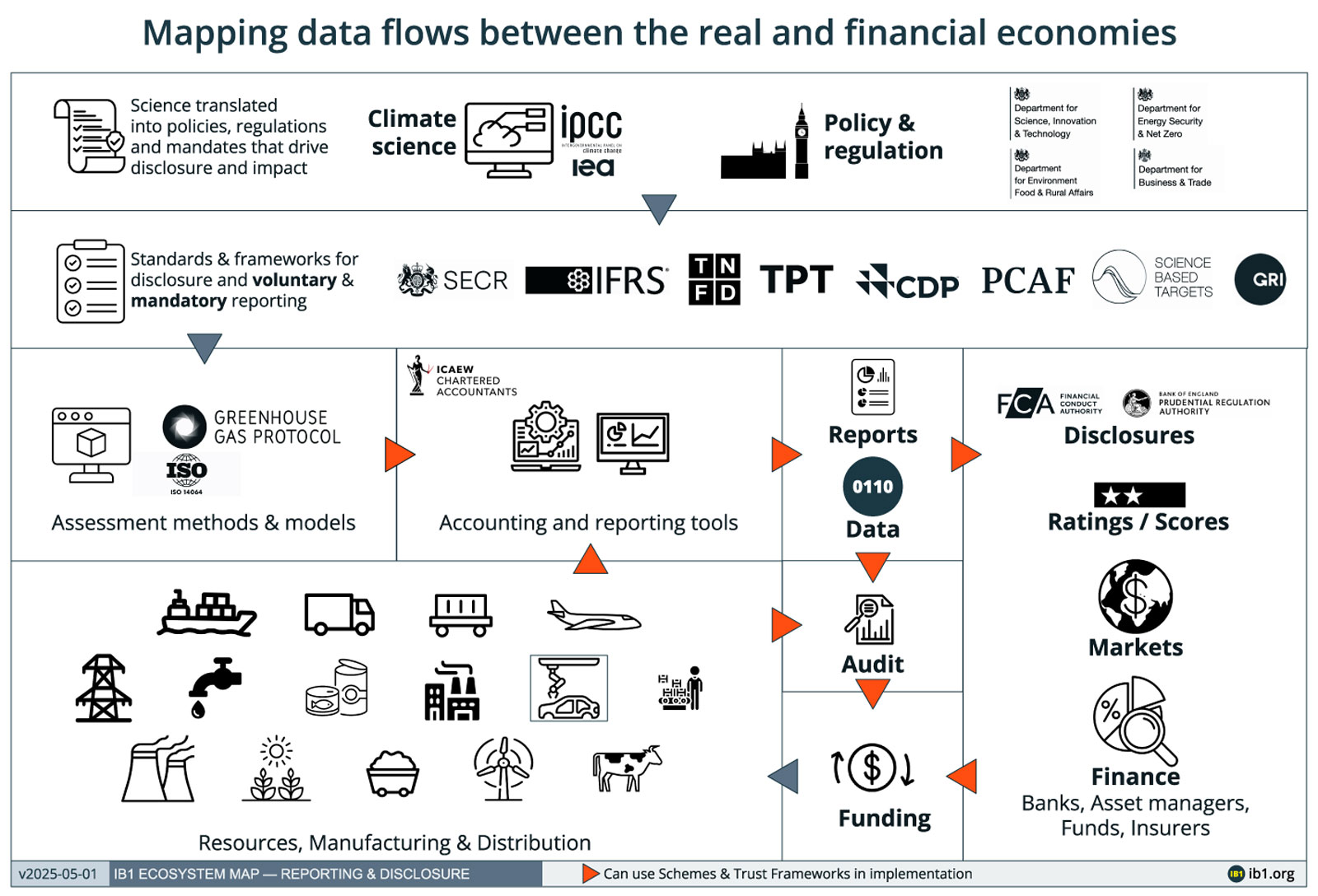
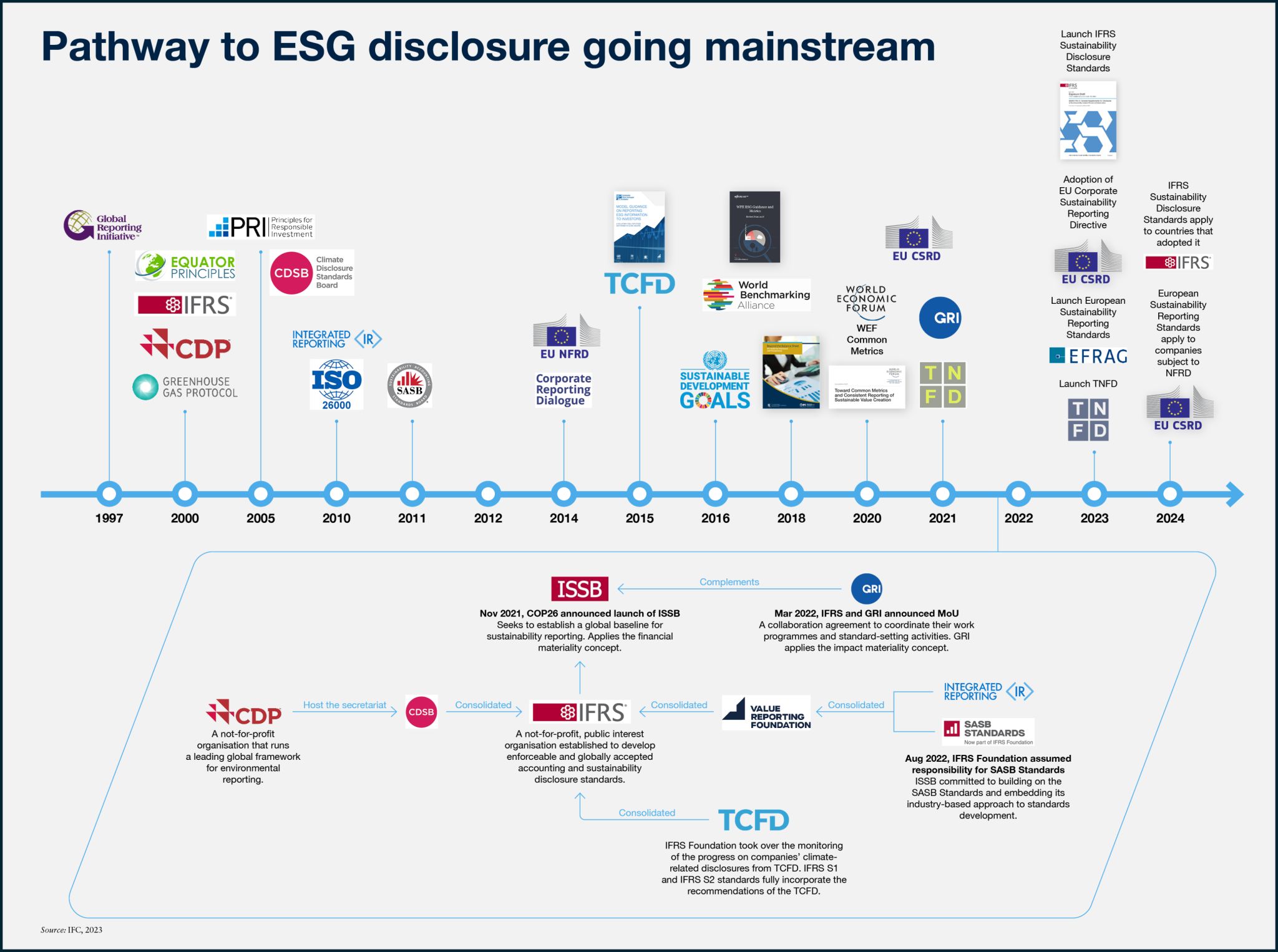
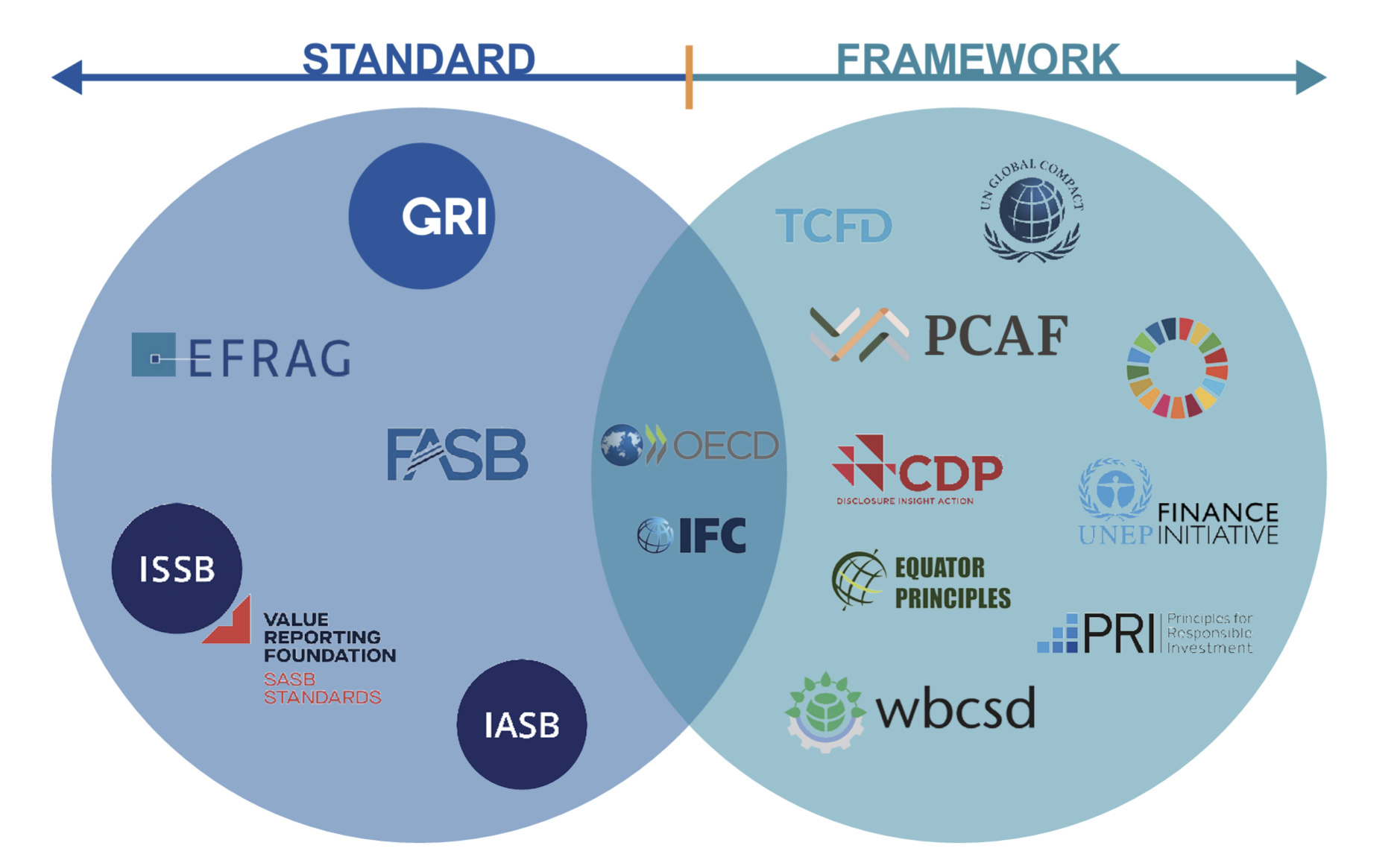
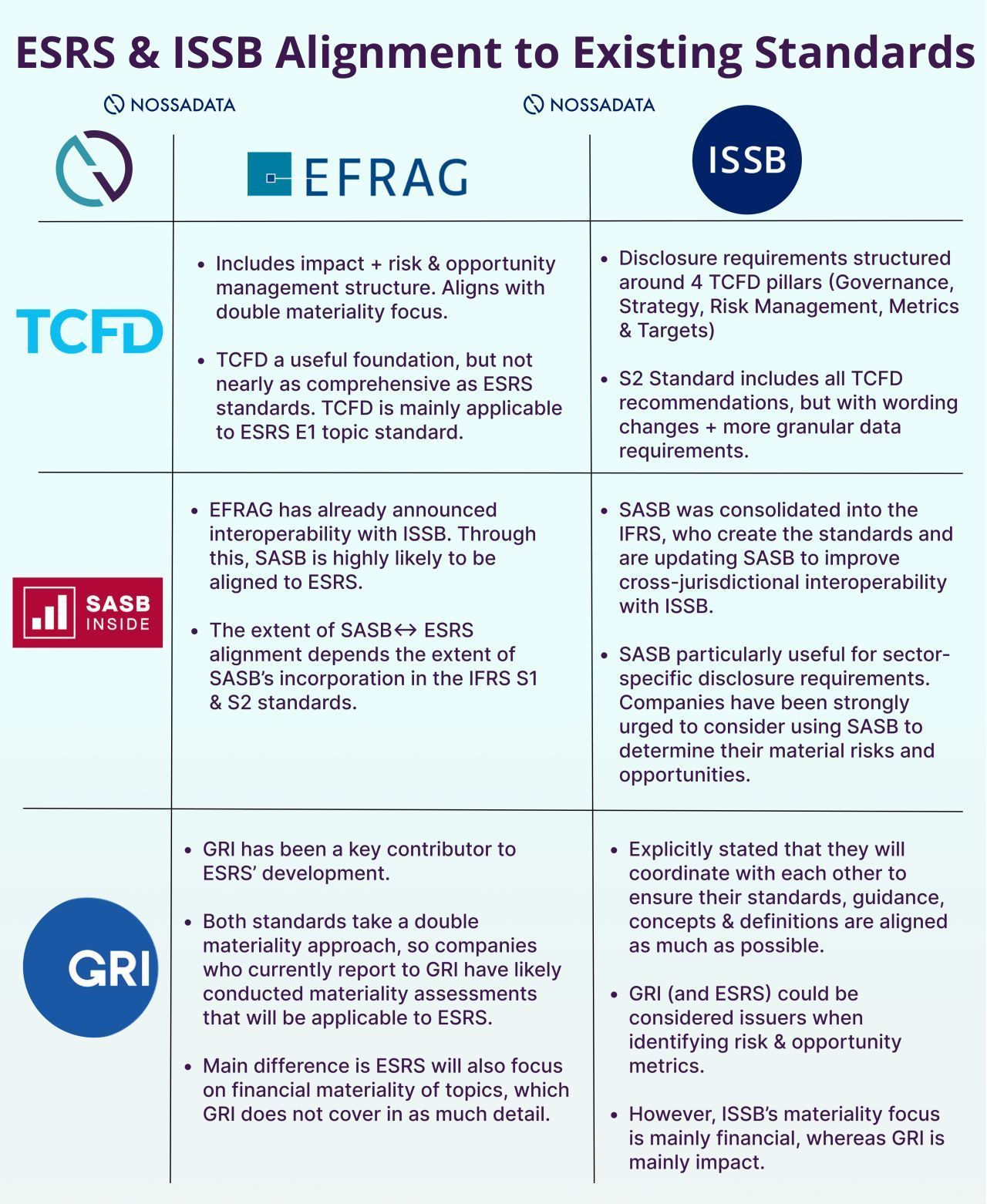
Prior versions
Changelog
- 2026-08-20: Restructured as a six-layer stack view. Added Layer 2 (data infrastructure). Refactored Layer 3 for IFRS Foundation consolidation. Added digital sustainability schema. Added data spaces and trust services. Reflected CSRD Omnibus and SBTi v2. Added Nature layer references. Updated aggregators with NZDPU and Climate Arc. Cleaned link rot.
- 2025-05-01: Noted GHG Protocol corporate suite update, EFRAG VSME, CSRD Omnibus proposal.
- 2024-06-26: Added TNFD / ESRS correspondence mapping.
- 2024-03-01: Added David Carlin’s ecosystem framing.
- 2023-11-01: First consolidated ecosystem overview.