Governance (for data sharing Schemes)
Contents
- How are Schemes governed at IB1?
- Roles and responsibilities in the Icebreaking process
- IB1 roles and responsibilities
- Member roles and responsibilities
- Processes
About Icebreaker One (IB1)
Icebreaker One (ib1.org) helps design data governance Schemes and implement data sharing across commercial markets. It runs services (Icebreaking and Trust Services) that convene and connect private and public sectors, to design and deliver operational Schemes that enable trusted data sharing. IB1’s prioritises Schemes that accelerate the transition to net zero.
IB1’s approach to data sharing governance is designed to support the long-term, cohesive and sustainable development and delivery of data-sharing programmes. Read more about IB1’s approach to data sharing governance.
How are Schemes governed with IB1?
Outcome: a clear set of rules, agreed upon by market participants that enable accurate and timely data sharing at a market-wide scale.
Definitions:
- Icebreaking: based on user needs, Icebreaking is a structured process for co-creating new Schemes (data-sharing principles, rules and standards to address a specific challenge). It convenes industry, regulators, trade associations and government to define how data sharing should work. Successful Icebreaking requires collaboration across commercial, legal, technical, policy and communications disciplines.
- Trust Services provide the underpinning governance, legal and technical services needed to enable data exchange between many organisations, and ensure this data is usable, comparable, machine-readable and trusted.
- Schemes can be operated within Trust Services environments. Together this determines what data can be shared, why, by whom and how, to address the given challenge or cause.
The work of defining, establishing and evolving how Schemes are governed is undertaken through Icebreaking, to shape a standardised approach that is fit for purpose for, and can be rapidly deployed across the market. It allows for the:
- collaborative, timely and legitimate establishment of rules (read more about IB1’s governance collaboration rules and principles)
- demonstrably addresses social, economic, environmental, public and private sector needs.
- delivers cross-industry alignment on the approach, including clear use cases, a roadmap for work, definitions of risks, gaps and opportunities, and recommended approaches and resolutions.
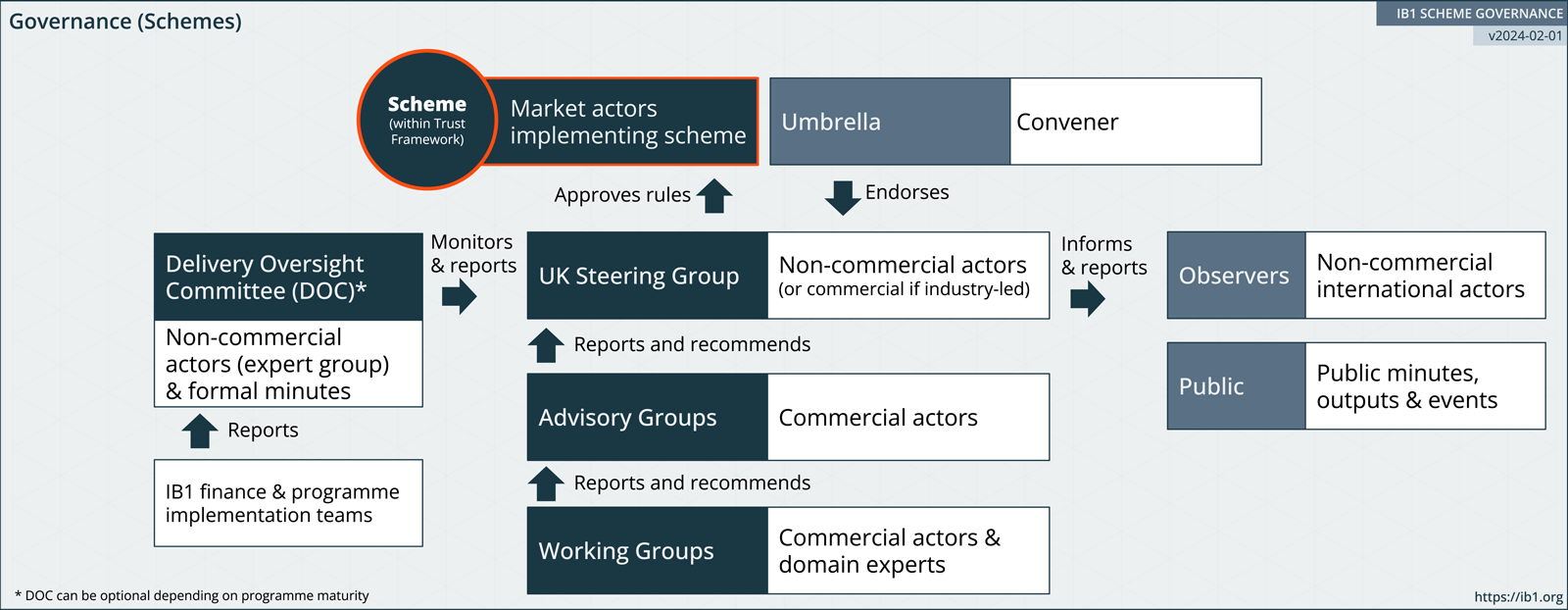
IB1 provides a secretariat service to facilitate Icebreaking by operating the following groups:
| Name | Purpose | Decision making role | Mandatory? |
| Steering Group (SG) | Strategic oversight of the Scheme as a whole and high-level integration with the overarching Trust Services. | Strategic decision-making with focus on overarching goals, resource allocation, and high-level project direction. | Yes |
| Delivery Oversight Committee (DOC) | Formal independent monitoring and reporting on Scheme delivery. | Independent monitoring and reporting to the SG (if required). In more mature Schemes, this may be a Special Purpose Vehicle that has independent Directors. | No |
| Advisory Groups (AGs) | Expert guidance and input structured by the five Icebreaking pillars. | Operational decision-making handling specific operational challenges, shaping technical developments, and co-producing processes, systems and rules (e.g. dispute management). | Yes |
| Working Groups (WGs) | Targeted, practical work on focused tasks, either within or across Icebreaking pillars. | Task-oriented decision-making focusing on completing specific assignments (e.g. data management procedures, specific aspects of regulatory compliance, engagement with identified stakeholder groups). | Yes |
Icebreaking has up to 5 Advisory Groups (detailed below)
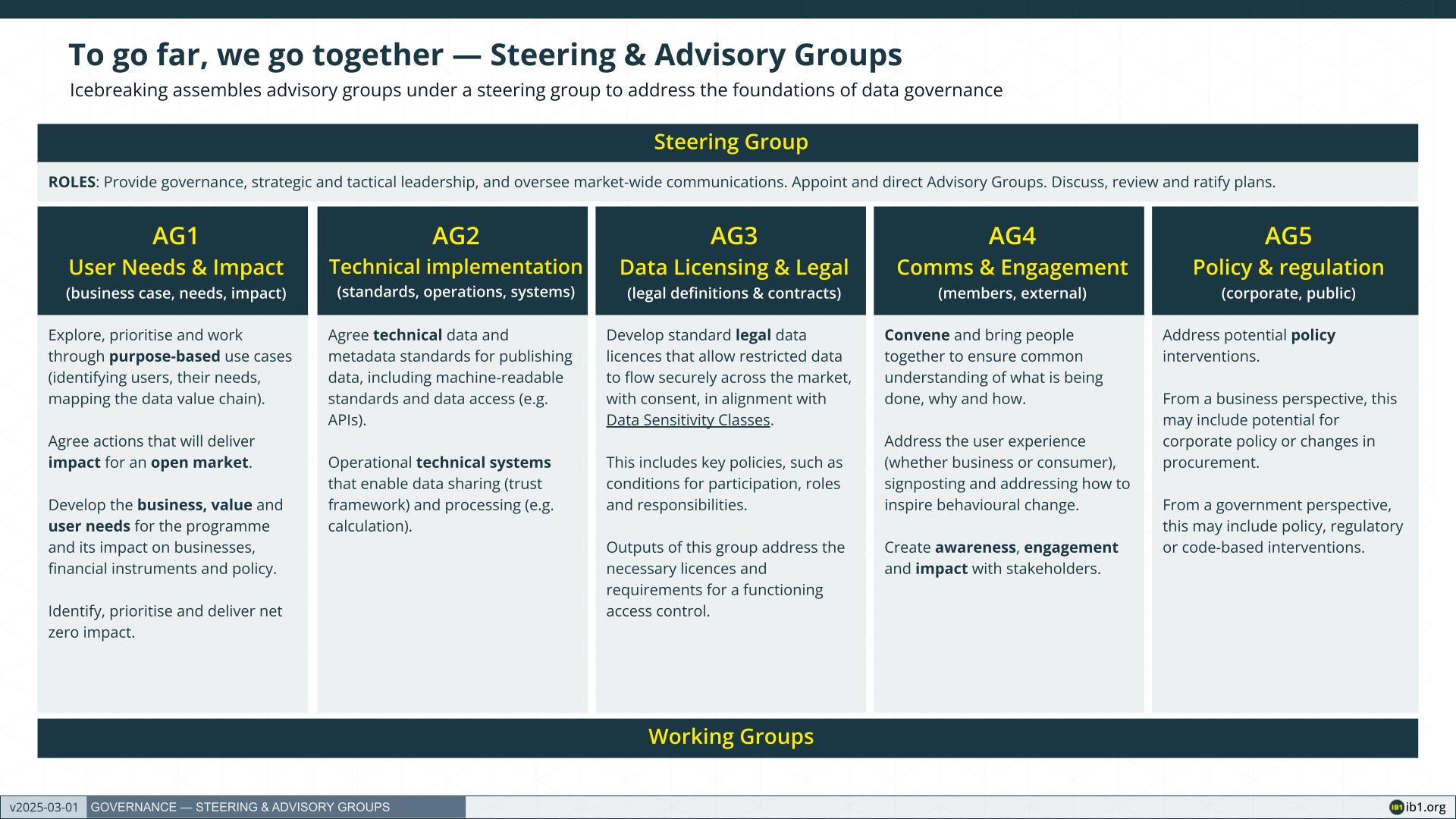
Aligning with good governance principles, the structure of and relationships between the groups outlined above is designed to ensure that:
- No individual or entity can take disproportionate or unaccountable control over Scheme governance.
- End user needs are clearly identified and met – and these needs are prioritised above individual or organisational standpoints.
- Processes and outcomes are clearly allocated and tracked, with groups being held accountable for progress.
- Processes and outcomes are robustly reviewed, with clear accountability chains between decision-making layers.
The next sections describe in detail:
- Rules and principles
- Roles and responsibilities
- Resources
- Processes
These elements are necessary to establish Scheme governance.
Roles and responsibilities in the Icebreaking process
Terms of Reference (ToR) https://ib1.org/terms/tor
Members of Steering and Advisory Groups must sign a formal agreement to Terms of Reference. These outline the structure of the groups, roles and responsibilities, time commitments, rules, values and guiding principles. If the member delegates an alternate or proxy for a meeting, they are asked to review Terms of Reference but do not need to sign.
Working Groups are made aware of the Scheme’s mission and values (within the ToR).
If a SG or AG member has not signed the Terms of Reference, they can be asked to no longer attend the meetings if they cannot abide by the Terms of Reference.
We also produce a clearly defined group scope which details the specific skills, expertise, group scope, timings, and deliverables of the group for the duration of the project (or phase of the project).
Governance Structure
Participants will include a wide range of subject matter experts to meet the diverse needs of the project, and to ensure it is representative of stakeholders.
Steering Group (SG)
Purpose: Programme oversight and review/adopt recommendations, hold Advisory Groups (AGs) accountable
Convened by: Regulator, industry coalition, or public-private partnership
Meeting frequency: Determined by programme needs (e.g., monthly, quarterly)
Key responsibilities:
- Signs off programme direction, outcomes, resourcing and planning as recommended by Advisory Groups
- Appoint Advisory Group Co-Chairs
- Can appoint a Delivery Oversight Committee
- Approve public minutes for dissemination (secretariat produces meeting minutes)
- Maintains whole programme risk register
- Holds the Advisory Groups to account on their defined scope
Members:
- National schemes: non-commercial actors (trade bodies, government, regulators)
- Industry-led schemes: commercial actors (non-exclusive), others by invitation
- Observers may be invited as appropriate. They are under no obligation to comment and their participation is not seen as an endorsement. Observers may be invited to provide updates on their own strategic positions if appropriate.
- Number: Typically 12-18 members for good representation
- One representative per organisation.
Member commitments:
- Must have formal endorsement from their host organisation with appropriate authority
- Attend and prepare for meetings
- Help in the dissemination of the work to the relevant communities
- Input into and sign-off documents
Delivery Oversight Committee (DOC) [optional]
Purpose: Independent monitoring and reporting. A pragmatic group working delivery partners on details not appropriate for the Steering Group, but for which Steering Group has requested independent review.
Appointed by, reports to: Steering Group
Frequency of meetings: quarterly (minimum)
Advisory Groups (AGs)
Purpose: Provide expert input to the programme to address commercial, non-commercial and public needs. Accountable for the definition of oversight, scope and adoption of Working Group recommendations. Where appropriate Advisory Groups can be merged.
Advisory Groups address the five pillars of data governance:
- User needs & impact: Identify user needs, explore / prioritise use cases, and mapping the data value chain
- Technical: Agree data and metadata standards, operational technical systems
- Licensing & Legal: standard legal data licences, apply data sensitivity classes to datasets identified
- Engagement & Communications: Address user needs, experiences, and create awareness and engagement for the programme
- Policy: Identify potential policy implications, blockers, or interventions
Appointed by, reports to: Steering Group
Frequency of meetings: Determined by programme needs (e.g. monthly, 6 weekly, quarterly)
Authority and responsibilities:
- Creates Working Group high-level tasks
- Signs off the Working Group recommended direction, outcomes, resourcing and planning
- Approve public minutes for dissemination (secretariat produces meeting minutes)
- Ensures outputs are cohesive, following the roadmap, addresses risks, gaps and opportunities, and recommends approaches and resolutions.
- Maintains a group risk register
- Holds members and workstream leads accountable and provides transparency for defined work packages
Members
- Subject matter experts who can act as representatives of their industry and not of their company or body – expertise must be contributed as impartially as possible.
- Blend of commercial and non-commercial actors
- Cross-sector external actors
- Multiple members from the same organisation may join an Advisory Group to enable additional expert advisors to contribute to discussions (nb: only one can be assigned voting rights).
Member commitments
- Formal endorsement from their host organisation to be a decision-maker, and have the capacity to steer the programme.
- Attend and prepare meetings
- Help in the dissemination of the work to the relevant communities
- Input into and sign-off documents
- Optionally attending additional interviews/meetings with researchers
- Optionally respond to consultations
Working Groups (WGs)
Purpose: Deliver specific work outputs as designated by the Advisory Group, and report back at the following meeting
Appointed by, reports to: relevant Advisory Group
Frequency of meetings: as required
Authority and responsibilities:
- Delivers high-level tasks outlined by an Advisory Group
- Produces outputs for dissemination. Ensures outputs are cohesive, follow the roadmaps, and address risks, gaps and opportunities, recommended approaches and resolutions.
- Informs the Advisory Group of any relevant risks
Members
- A small, focussed group of subject matter experts that can address the work required.
- Includes a blend of commercial and non-commercial actors.
- Can invite non-programme members to participate if appropriate (e.g. domain experts)
- Typically comprises of 3-5 experts working on a particular output
Member commitments
- Must have formal endorsement from their host organisation with appropriate authority
- Attend and prepare meetings
- Help in the dissemination of the work to the relevant communities
- Input into and sign-off documents
Resources, roles and responsibilities
IB1 resources and operates the Icebreaking process, including, where appropriate,
- Providing a co-chair of Steering Group
- Providing a co-chair of each Advisory Group
- Operating the Steering, Advisory and Working Group processes (as Secretariat)
- Running implementation teams and operations with Members
- Output delivery (research, reports, content creation, implementation, comms)
- Managing contracts, budgets and financial processes
- Providing overall programme management, monitoring and reporting
IB1 roles and responsibilities
- IB1 Secretariat & Administrative support: IB1 coordinates and supports the Steering, Advisory and Working Groups to ensure the programme is making effective and timely decisions and is aligned with strategic objectives. IB1 provides administrative support including: meeting arrangements, pre-read and agenda dissemination, note-taking and drafting of formal minutes. Formal public and internal minutes are maintained at Steering and Advisory Group levels.
- IB1 researchers: Research support is provided to conduct desk and primary research, prepare materials for publication, and prepare materials for the Advisory Group meetings.
- IB1 domain experts (project dependent) IB1 domain and subject matter experts contribute to the Advisory Group by providing presentations, feedback and expertise during meetings.
Role of co-chairs in all groups
Co-chairs will include: one individual with deep domain/sector expertise and one with deep expertise related to Schemes, Trust Services, Open and Shared data.
This is to ensure that topics represent the interests of all members and no individual party is driving forward the agenda without consensus. IB1 will recommend an independent co-chair.
Co-chairs must:
- Ensure orderly running of the meetings
- Act to drive the programme forward (holding workstreams accountable and transparent)
- Ensure the groups are inclusive and capture stakeholder feedback
- Work alongside other co-chairs, working group leads, and any programme teams
- Represent the group at the Advisory or Steering Group meetings on an as-needed basis
- (AG co-chairs) Offer scope and direction to working group leads and support the delivery of working group outputs
- (IB1 co-chair) Ensure external co-chair is up to date on programme progress
Role of members in all groups
- Voting member – primary representation from a member organisation, with voting rights
- Supporting member – additional representation from a member organisation attending alongside the voting member, no voting rights
- Observer – representative from a regulatory/governmental organisation, no voting rights
- Alternate member – attending on behalf of a member, with voting rights
- Alternate observer – attending on behalf of an observer, no voting rights
Processes
Membership selection, tenure and maintenance
Steering Group, Advisory Group and Working Group member selection must be open, voluntary, and open to iteration. For certain partner-funded programmes, attendance at Advisory Groups may be contingent on a programme-specific membership including a budget contribution.
Steering Group membership should appropriately reflect particular programme needs (e.g. consumer advocate groups, organisations of different sizes, regulators, academia). If a gap in group membership is identified (skills/expertise/representation), the secretariat will attempt to connect with an organisation or individual which can fill the gap.
Advisory Group members volunteer for the groups by contacting the secretariat, either via email or through a form. A clearly defined scope details the required skills and expertise, and members are asked to self-select the most appropriate colleague to join the group.
Membership tenure is for a minimum of one year, or can be for as long as the group determines practical, or as the participant deems themselves relevant to the group scope. Co-chairs and secretariat must routinely review participant trackers, and request members to ensure they are the correct individuals within their organisation to advise (including replacements should individuals change roles in their host organisation). The co-chairs must also assess, address and document that groups have the required skills to fulfil the tasks. Membership review is conducted quarterly.
Working Groups are convened between the Advisory Group meetings to address a specific identified topic, challenge, or risk and tenure is for only the amount of meetings required to address the topic (i.e. smaller topics may only have 1 meeting, whereas other topics require more). Once the groups are proposed at an Advisory Group meeting, they are formed through:
- Advisory Group members volunteering or nominating colleagues for a group. Working groups are open to all, including domain expert non-Advisory Group members.
- Members from any other Advisory Group signing up asynchronously (e.g. survey form, email) and/or nominating domain experts who should be approached to participate
Working Groups should appoint a leader who will schedule the meetings and ensure outputs are documented and presented to the next Advisory Group. This role can be rotated among group members.
For each meeting, participant attendance is recorded. The secretariat reviews the tracker sheet and calculates the percentage for each participant’s attendance. If a participant has low attendance, the secretariat reaches out to the participant and ensures they want to continue to be in the group, or if any alternative colleague should be nominated.
Co-chair determination
The secretariat will write a ‘Role Description’ to outline the role, responsibilities, and time commitments. Co-chair determination is dependent on the programme and often falls into:
- Raising the need for a co-chair to the Steering Group to solicit nominations
- If there is a group of organisations already engaged before creating SG/AGs, raising the need within a forum and accepting nominations from them
- Secretariat can make efforts to identify of co-chair who suits the role if no person is nominated
- Self-nominations to co-chair, which can also rotate between different members of a group if deemed to be an appropriate process
Action tracking and agenda-setting
Actions, decisions and opportunities for further work are identified and noted at the end of each meeting. The secretariat produces a follow-up email which includes: key actions, topics which were discussed, and notes key points raised by the group. Key actions are also noted in an action tracker document so the secretariat can follow up on key actions, and update the group on the status of those actions at the next meeting. If the actions are cross-AG (i.e. Advisory Group 2 asking a question of Advisory Group 1), these actions are raised with the co-chairs of the other relevant Advisory Group.
Agenda Setting
Topics are selected by the programme leads and Steering Group co-chairs to ensure relevant items are tabled and voted on as appropriate. This is done through a 30-45 min agenda-setting session where topics are discussed, and an agenda is drafted to be shared with members before the event. The voting items and pre-read which are required for the meeting must be confirmed at this time.
Determining meeting cadence
Steering Group, Advisory Group, and Working Group cadence is set by the programme needs, and determined through collective agreement of the respective groups. We recommend a typical cadence of 6-8 weeks or each financial year quarter, depending on project needs and scale.
To change the cadence of the meetings (i.e. if it is raised in a meeting that future meetings should occur more or less frequently), the secretariat will send out a survey to ensure all members are aligned. If over 2/3 of the group want to change the meeting cadence, it can change to the preferred cadence, given appropriate resourcing is available. Such decisions should also be endorsed by the Steering Group if there is a financial impact (e.g. additional secretariat support).
Course corrective measures
The Steering Group function reviews milestones, adopts and endorses Advisory Group outputs, or provides feedback if the work is deemed incomplete or not fit for purpose.
For example, if the Steering Group determines an Advisory Group did not answer a query with enough stakeholder input or missed key aspects in analysis, the Steering Group would send such feedback to the Advisory Group and hold the group accountable for delivering what is needed.
The Advisory Group function reviews milestones, adopts and endorses Working Group outputs, or provides feedback if the work is deemed incomplete or not fit for purpose.
For example, if an Advisory Group determines a Working Group did not answer a query with enough stakeholder input or missed key aspects in analysis, the Advisory Group would send such feedback and hold the group accountable for delivering what is needed.
Groups must manage risks and mitigations relevant to their scope, and report to a Steering Group where appropriate along with any course change recommendations.
Group scope definitions detail the expertise required and members are asked to select the most appropriate colleague(s) to join the group. If there is deemed to be a gap in skills and expertise (by group members, co-chairs, regulators etc), the secretariat must raise this concern within the group and call for members within the group to satisfy that skill/expertise or search for new members to join and fulfil those needs, or resource these via IB1.
Meeting Quorum
A recommended quorum is defined by default as having a minimum of two-thirds of the voting Members present. If quorum is not met, a meeting may be cancelled or rescheduled.
Voting and Group decision-making
Steering Group members must have the capacity, ability and authority within their organisation to steer the programme and vote on and/or endorse key decisions.
Steering Group voting quorate is decided by the group to ensure the process is clear and mutually agreed. Items are raised to the Steering Group for consideration if:
- It is a critical or material decision for the programme (i.e. impacts time/reputation)
- It impacts financial decisions
- A risk is raised to high status and requires advice on mitigation
Advisory Groups decide which recommendations they wish to take forward. Members are kept up to date with programme progress and advise and review new developments or updates. If an AG is blocked, in disagreement, or unable to advise on a topic, it may be brought to the Secretariat and/or the SG.
The topics groups vote on is determined by the programme team and co-chairs, in alignment with the business plan and Steering Group strategy, determined in the agenda setting session (detailed above). Items are raised to the Advisory Group for consideration if:
- It is a programme decision point
- A material project change (i.e. change of focus, direction, budget, next steps)
- Requires member guidance.
The secretariat will also advise on voting points needed for transparency and/or best practice.
How to Vote – Asynchronous voting and quorate
Voting and/or approval of items will be electronic (e.g. Google Forms, email, MS Word) which the Secretariat will record in formal voting form(s). When key decisions must be made, the survey form will be sent out at least one week prior to the meeting, with supporting materials.
In-meeting voting can be conducted using online tools such as ranked voting for prioritising use cases, Google Forms, or emailed MS Word documents. Unless agreed otherwise, voting will occur during the meeting, with participants given enough time to complete any required forms during the call.
To ensure maximum participation, the voting form(s) will remain accessible for seven (7) calendar days after the meeting. This allows members to submit or amend their votes if discussions or dependencies during the meeting have significantly influenced their decisions. If multiple votes are submitted by the same organisation, only the most recent vote will be recorded. The Secretariat will monitor votes, follow up with those who have not yet participated, and send a reminder one day before the voting deadline.
Votes are concluded once a majority of voting members have cast their vote, or not raised any objections within a given timeframe. Majorities are defined by the group, dependent on the decision being made (50% or ⅔ may be appropriate as determined in advance by the group). Abstentions and comments will be noted.
If a quorum is not achieved, a final email reminder will be sent directly to the members who have not voted. If further intervention is required, a final reminder can be made by the co-chairs urging the members to participate (by email or phone). If the vote is unable to reach quorum following targeted reminders, this should be escalated to the Steering Group for direction. A member review can be undertaken to address the lack of engagement from members who do not vote.
Vote outcomes will be confirmed with co-chairs and summarised in a document shared with all members within one week after the voting deadline. The summary will include the vote questions, key documents, total number of votes, and results (approvals, abstentions, and non-approvals). Individual votes will remain anonymous and not shared with Advisory Group members.
The Secretariat may share reasons for abstentions or non-approvals with the programme team to address any issues or barriers. All vote outcomes will be recorded in the minutes. Public Advisory Group minutes will be openly published on the IB1 website.
Voting Quorum
Default quorum is defined as a minimum of two-thirds of the voting Members present. Amendments to this default threshold can be proposed by the membership and thresholds can be customised for specific votes as required.
Voting rights are one vote seat per organisation. Observers and supporting members do not hold voting rights. Co-chairs may vote on behalf of their organisation if there is no other member from their organisation. Votes can be cast by members or their proxy representative during an AG meeting or asynchronously via email or voting form.
Changelog
| 2025-03-01 | Updated AG diagram with clearer language |
| 2025-01-30 | Minor text edits for clarity |
| 2025-01-06 | Edited for clarity, brevity, and detail in voting sections |
| 2024-02-23 | Iteration to clarify language and concepts. No material changes to processes. |
| 2024-02-01 | First public release |